
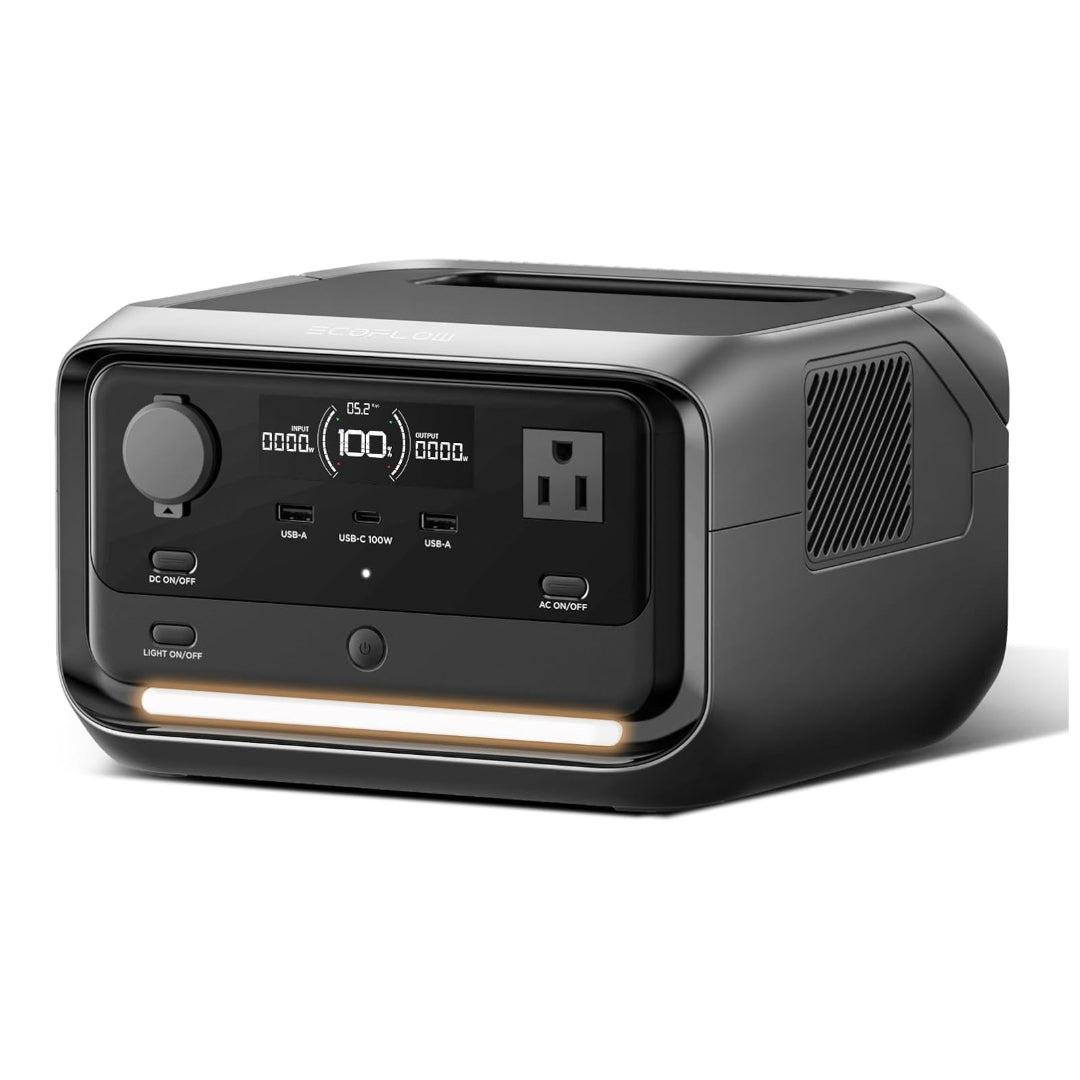
EcoFlow RIVER 3 Plus Power Station
As an Amazon Associate I earn from qualifying purchases.
When the electricity goes off, even a short interruption can be inconvenient. A computer shuts down, the internet disappears, or an essential piece of equipment suddenly becomes unusable.
The EcoFlow RIVER 3 Plus Power Station offers a compact way to keep suitable devices running when mains electricity isn’t available.
With a 286Wh LiFePO4 battery, 600W AC output, rapid charging and expandable storage, it is designed for everyday backup power, camping and working away from conventional electrical outlets.
However, its relatively small battery makes understanding power consumption particularly important.
Compact Power With Useful Features
The RIVER 3 Plus combines rechargeable battery storage with three AC outlets, two USB-A connections, a 100W USB-C port and a 12V car-style output.
Its 600W continuous AC capacity can support a variety of compatible electronics, including laptops, routers, lighting and smaller electrical appliances.
EcoFlow also provides X-Boost technology for certain higher-wattage appliances, although this doesn’t increase the unit’s normal continuous output rating.
The 286Wh LiFePO4 battery is rated to retain at least 80% of its original capacity after approximately 3,000 charging cycles under specified test conditions.
A clear front display provides information about remaining battery capacity, incoming charging power and electricity being supplied to connected devices.
Wi-Fi and Bluetooth connectivity allow additional monitoring and settings through EcoFlow’s smartphone app.
Portable Without Being Flimsy
At approximately 10.4 pounds, the RIVER 3 Plus feels more substantial on paper than a conventional portable charger, but it remains manageable for moving around the house or taking on a trip.
Its compact rectangular body measures approximately 9.2 × 9.1 × 5.8 inches.
The integrated carrying handle, accessible controls and clearly arranged connections make it practical for temporary setups.
It can sit beside a desk, travel in a vehicle or provide electricity at a campsite, provided the environment is suitable.
For comparison, Gizrpt’s Anker SOLIX C1000 Portable Power Station offers substantially greater energy storage and higher continuous output, but comes in a noticeably heavier package.
The EcoFlow is better suited to buyers who prioritise compact dimensions over extended high-power operation.
What You Should Know Before Buying
The 286Wh battery isn’t particularly large
This is the most important limitation.
Battery capacity and output wattage measure different things.
The 600W rating describes how much power the station can continuously supply through its AC system. The 286Wh capacity describes the energy stored inside its battery.
A device consuming 50W could theoretically run for around five hours before accounting for conversion losses and the station’s own electrical consumption.
A 300W appliance would exhaust the available energy much more quickly.
Actual runtime depends on the connected equipment, operating conditions and energy lost during conversion.
The RIVER 3 Plus is therefore better suited to essential electronics and shorter backup sessions than powering demanding household appliances for extended periods.
High-powered appliances need careful checking
The 600W continuous AC output will not accommodate every appliance.
Electric kettles, portable heaters, hairdryers and many cooking appliances can demand considerably more power.
EcoFlow’s X-Boost feature can accommodate certain appliances with higher nominal ratings by adjusting the output conditions.
However, this isn’t equivalent to providing a continuous 1,200W supply at normal voltage.
Some electronically controlled appliances, precision equipment and motor-driven devices may not operate correctly with X-Boost.
Always check the intended appliance’s electrical requirements, including starting surges.
UPS protection isn’t universal
One of the RIVER 3 Plus’s most useful features is its integrated uninterruptible power supply functionality.
EcoFlow specifies an automatic transfer time of less than 10 milliseconds when switching from mains electricity to battery power under supported conditions.
That can help protect compatible computers, networking equipment and other electronics from brief power interruptions.
However, it isn’t a zero-transfer online UPS.
Some sensitive equipment may still restart or shut down during the changeover.
Users should confirm that their devices tolerate the specified transfer time before relying on the system.
It should not be treated as a guaranteed power source for life-support equipment or other safety-critical applications.
Expansion requires extra equipment
The standard RIVER 3 Plus contains 286Wh of battery storage.
EcoFlow supports compatible EB300 and EB600 expansion batteries, increasing total capacity to approximately 572Wh or 858Wh.
This flexibility is useful because buyers can begin with a smaller unit and increase storage later.
However, the expansion batteries are separate purchases, adding weight, physical bulk and further charging considerations.
Anyone expecting the advertised maximum expanded capacity straight out of the box will be disappointed.
Solar charging isn’t automatic
The RIVER 3 Plus supports solar input up to 220W with compatible equipment.
That makes it useful for outdoor activities and locations without conventional mains electricity.
However, a solar panel isn’t included with every power station package.
Charging performance also depends on sunlight, panel positioning, weather and electrical compatibility.
Even under favourable conditions, real-world charging may take longer than the manufacturer’s fastest quoted figures.
Buyers should confirm the included accessories and suitable panel specifications rather than assuming any existing solar panel will work.
Battery temperature limits matter
LiFePO4 batteries offer useful longevity, but temperature still affects operation.
EcoFlow specifies a charging temperature range of approximately 32°F to 113°F.
Charging below freezing is outside that permitted range.
Discharging is supported over a wider temperature range, but cold conditions can still affect usable battery performance.
This matters for winter camping, unheated garages and emergency equipment stored in cold environments.
The power station should also be protected from rain, excessive moisture and unsuitable storage conditions.
It is not a waterproof outdoor generator.
Rapid charging has practical compromises
EcoFlow advertises a full AC recharge in approximately one hour under suitable conditions.
That is convenient when electricity is available only briefly or the station needs preparing before a trip.
Nevertheless, fast charging can involve increased fan activity and higher demands on the electrical supply.
Charging behaviour may also vary with battery temperature, settings and available input power.
Users who prefer quieter operation can investigate the supported charging controls rather than always relying on maximum charging speed.
It isn’t a whole-home backup system
The RIVER 3 Plus supplies electricity to compatible devices connected to its own outlets.
It cannot independently power an entire house, operate large electrical installations or replace a properly designed residential backup system.
It must never be connected to household wiring through improvised plugs or backfeeding arrangements.
People considering broader electricity management may also find our Emporia Vue 3 Energy Monitor guide useful for understanding household energy consumption.
Monitoring electricity and storing backup power are different functions, but both benefit from understanding how much energy equipment actually uses.
Who Should Probably Avoid This Product?
Anyone needing to run an electric heater, large refrigerator or substantial household load for many hours should consider a larger power station.
The same applies to households requiring extended backup electricity for several appliances simultaneously.
People who only want to charge phones, earbuds and small USB devices may find an ordinary power bank more convenient.
For desktop charging without battery storage, our Anker Prime 250W Charging Station covers a different approach to powering several compatible devices.
The RIVER 3 Plus is also unsuitable for buyers expecting guaranteed uninterrupted operation of sensitive or safety-critical equipment without compatibility testing.
Who Will Benefit Most?
The EcoFlow RIVER 3 Plus makes sense for home-office workers who want short-term backup power for compatible computers, routers and networking equipment.
Campers and weekend travellers may appreciate being able to charge electronics and operate suitable small appliances away from electrical hookups.
Photographers, remote workers and people with portable electronic equipment can benefit from its combination of AC and USB connections.
Its compact size is particularly attractive when storage space matters more than maximum battery capacity.
For more practical household technology, explore Gizrpt’s Home Tech & Appliances guides.
Practical Power for Smaller Jobs
The EcoFlow RIVER 3 Plus offers a thoughtful combination of portability, useful connections and rechargeable battery technology.
Its rapid charging, UPS functionality and expandable capacity provide flexibility, while the compact housing keeps it manageable for everyday storage and transport.
The principal compromise is its limited energy capacity. High-powered appliances, extended outages and demanding electrical installations require more substantial solutions.
For appropriately sized loads, however, the RIVER 3 Plus provides a convenient way to keep useful electronics operating when an ordinary wall outlet isn’t available.
As an Amazon Associate I earn from qualifying purchases.
Opens Amazon (paid link)