
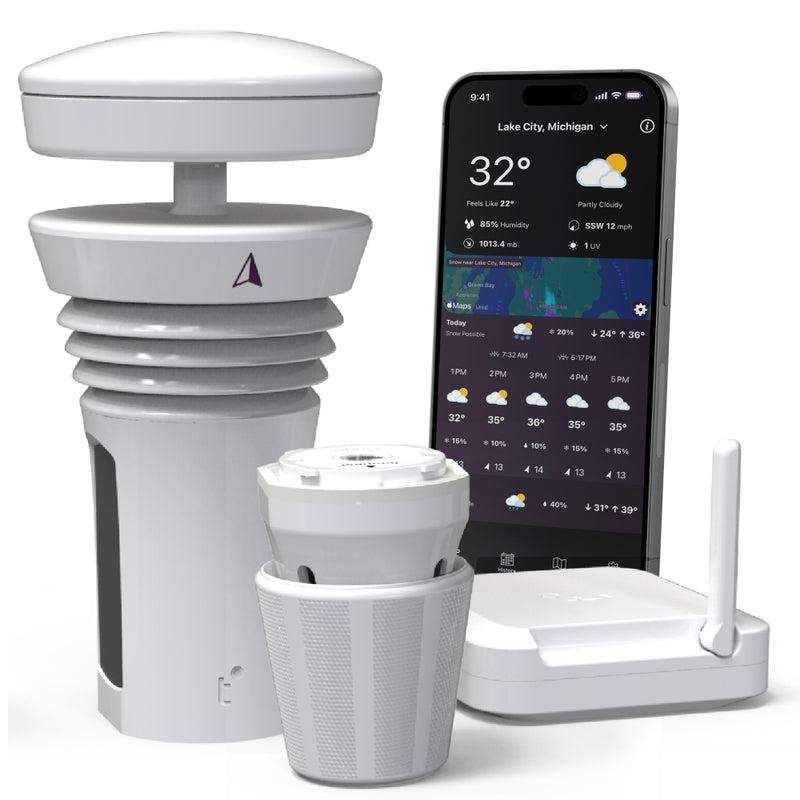
WeatherFlow Tempest Weather Station
As an Amazon Associate I earn from qualifying purchases.
The weather forecast might promise sunshine, yet your garden could be experiencing an unexpected shower. Wind conditions can also change dramatically between neighbouring properties, particularly where buildings, trees and surrounding terrain influence the local climate.
The WeatherFlow Tempest Weather Station offers a fascinating way to understand what’s actually happening outside your home.
Instead of relying entirely on regional forecasts, this smart weather-monitoring system collects information from your own outdoor environment, including wind speed, rainfall, temperature, humidity, solar radiation and nearby lightning activity.
Its unusual sensor design, solar-powered operation and smart-home integration make it particularly interesting. However, correct installation and realistic expectations about measurement accuracy are essential.
A Weather Station Without Moving Parts
The Tempest takes a different approach from many traditional domestic weather stations.
Rather than using spinning wind cups and a mechanical tipping-bucket rain gauge, it measures wind through ultrasonic sensing and rainfall through a patented haptic sensor.
The ultrasonic system detects changes in sound transmission caused by moving air, allowing it to calculate wind speed and direction.
Rainfall is measured through vibrations produced when raindrops strike the sensor surface.
This construction eliminates several moving components that can wear, become obstructed or require regular cleaning.
The main outdoor unit has a clean white cylindrical design that looks considerably more modern than conventional weather stations with exposed measuring arms.
Its compact housing also contains sensors for air temperature, humidity, barometric pressure, UV index and solar radiation.
A lightning sensor provides notifications of detected activity up to approximately 25 miles away.
Together, these measurements give homeowners a detailed picture of local weather conditions.
Local Weather Information on Your Phone
The Tempest communicates wirelessly with an included indoor hub, which connects to a compatible home Wi-Fi network.
Once configured, the Tempest app displays current measurements, historical observations and weather forecasts.
Users can examine changing temperatures, monitor wind conditions and review rainfall patterns without going outside.
The app also provides custom notifications for selected weather events.
For gardeners, this can be particularly useful when deciding whether plants need watering or outdoor work should be postponed.
WeatherFlow’s forecasting system combines information from the station with additional weather data and modelling rather than relying on one sensor alone.
The system also supports selected smart-home integrations.
For example, compatible irrigation equipment can use weather information to help make watering decisions.
Our Rachio 3 Smart Sprinkler Controller guide explores how intelligent irrigation can respond to changing conditions.
However, local weather monitoring and automatic garden watering remain separate functions. The Tempest doesn’t operate sprinkler valves by itself.
What You Should Know Before Buying
Installation location affects accuracy
This is arguably the most important consideration.
Although the Tempest is designed for straightforward installation, sensor positioning has a substantial effect on its measurements.
WeatherFlow recommends an open location with good sunlight exposure and suitable clearance from buildings, fences, trees and other obstructions.
For many households, installing the station approximately six to eight feet above the ground provides a practical balance between accessibility and measurement quality.
However, that doesn’t mean every reading will match official meteorological measurements.
Wind speed is particularly sensitive to nearby structures.
A station mounted behind a house may record considerably lower wind speeds than a sensor positioned above the surrounding rooftops.
Similarly, walls, paved surfaces and nearby heat sources can influence temperature readings.
Choosing a convenient mounting position without considering these effects can reduce the usefulness of the data.
Haptic rainfall measurement has limitations
The Tempest’s rain sensor is one of its most distinctive features.
It measures the vibrations produced by raindrops striking the unit rather than collecting water in a conventional gauge.
This eliminates the moving tipping mechanism found in many traditional rain gauges.
However, the technology is sensitive to unwanted vibration.
A flexible mounting pole, loose bracket or nearby moving structure can introduce disturbances that affect rainfall measurements.
WeatherFlow specifically advises against mounting arrangements that vibrate excessively.
The system also uses additional weather information and processing to improve rainfall estimates.
This means recorded accumulation may differ from the amount collected by a nearby manual rain gauge.
For general garden monitoring, these differences may be acceptable.
Anyone requiring highly controlled rainfall measurements for scientific or professional purposes should investigate whether the Tempest meets their particular accuracy requirements.
It cannot measure snowfall depth
The Tempest can detect rainfall, but its haptic rain sensor does not directly measure accumulated snow depth.
It cannot determine how many inches of snow have settled on the ground.
This matters in regions where winter snowfall is a significant part of the local climate.
Users wanting detailed snow accumulation measurements will need an additional method or instrument.
The station may still provide useful winter temperature, pressure and wind information, but it should not be mistaken for a complete snow-measuring system.
Solar charging depends on exposure
The outdoor sensor uses integrated solar charging with onboard energy storage.
This avoids the need to run an electrical cable to the installation point.
However, reliable charging depends on receiving sufficient sunlight.
Heavy shade, dense tree cover or poor solar-panel orientation can affect battery charging.
WeatherFlow recommends positioning the solar panels appropriately for the hemisphere and avoiding locations with unnecessary shading.
The standard Tempest should not be assumed to provide indefinite operation in deeply shaded locations.
Buyers should investigate the manufacturer’s available power accessories if their intended mounting position receives limited sunlight.
The indoor hub needs compatible Wi-Fi
The included hub requires a suitable 2.4GHz Wi-Fi connection.
It does not connect directly to a 5GHz-only network.
WeatherFlow also identifies restrictions involving certain enterprise networks and captive-portal arrangements.
Anyone using a complicated home network should check these requirements before installation.
The outdoor sensor communicates with the hub through a separate wireless connection, which has its own range limitations.
Thick walls, metal structures, interference and long distances can reduce reliability.
Testing the connection before permanently mounting the sensor can prevent considerable frustration.
There is no dedicated display in the standard package
Unlike many conventional weather stations, the Tempest doesn’t include a standalone tabletop weather display.
The main interface is the smartphone app or compatible web-based viewing system.
For people who already enjoy connected technology, that may be entirely satisfactory.
However, someone who wants to glance at a physical screen in the kitchen may find the arrangement less convenient.
A compatible tablet or separate display solution can provide a more permanent information screen, but that requires additional equipment.
Lightning detection isn’t a safety guarantee
The Tempest can detect lightning activity up to approximately 25 miles away.
This is a useful feature for identifying developing storms and receiving notifications.
However, its lightning sensor is not perfect.
WeatherFlow acknowledges that some strikes may be missed and that nearby electromagnetic interference can affect detection.
The system uses additional data processing to improve reporting, but the presence or absence of a notification should never determine whether outdoor conditions are safe.
If thunder is heard or threatening weather approaches, users should follow recognised lightning-safety guidance rather than relying exclusively on the station.
It isn’t suitable for moving installations
The Tempest is intended to monitor weather from a fixed location.
Although people may be tempted to mount it on a recreational vehicle or boat, WeatherFlow does not design the system for routine mobile operation.
Its rainfall sensor can respond to vibration, while wind-direction measurements depend on correct orientation.
Forecasting and calibration features also depend on consistent location information.
Moving the station frequently can therefore reduce measurement reliability.
Travellers needing weather information on the road should consider equipment specifically intended for mobile use.
Smart-home integrations require compatibility
Tempest supports services including Alexa, Siri, IFTTT and compatible irrigation platforms.
These integrations create interesting possibilities, but they shouldn’t be mistaken for universal compatibility with every smart-home product.
Available functions depend on the individual platform, software support and configuration.
For example, homeowners may be able to create useful weather-based routines, but the Tempest cannot directly control arbitrary appliances without appropriate compatible equipment.
Internet connectivity and third-party services may also affect the availability of particular automations.
Buyers should check the specific integration they intend to use rather than assuming every advertised platform supports identical features.
Long-term reliability still needs consideration
The absence of moving sensor mechanisms reduces some traditional maintenance requirements.
However, the Tempest remains an outdoor electronic instrument exposed to sunlight, rain, wind and changing temperatures.
Its mounting hardware must remain secure, and the sensor should be inspected periodically for damage or obstruction.
Solar charging and wireless connectivity also deserve occasional checks.
The product is designed for outdoor operation, but no electronic device is completely immune to environmental wear.
Its convenience comes from reduced mechanical maintenance, not from eliminating ownership responsibilities entirely.
Who Should Probably Avoid This Product?
People who only want a basic indoor temperature reading or occasional local forecast may find the Tempest unnecessarily elaborate.
The same applies to anyone who prefers a traditional weather station with a permanently visible physical display.
Homeowners unable to provide a suitable outdoor mounting location may struggle to obtain representative measurements.
Users requiring certified scientific observations, direct snow-depth measurement or specialised professional instruments should carefully examine the system’s limitations.
It is also less suitable for households without reliable compatible Wi-Fi or where the intended sensor location receives very little sunlight.
Who Will Benefit Most?
The Tempest is particularly appealing to homeowners who enjoy understanding their local environment in greater detail.
Gardeners can monitor rainfall, temperature and solar conditions, while weather enthusiasts may appreciate exploring historical trends and local observations.
Smart-home users can investigate useful weather-responsive automations with compatible equipment.
People who enjoy observing nature may also appreciate how connected outdoor technology reveals activity that might otherwise go unnoticed.
For another approach to enjoying the garden, our NETVUE Birdfy Smart Bird Feeder guide explores close-up wildlife monitoring through a connected camera.
The Tempest’s solar-powered operation also makes it an interesting addition to suitably equipped outdoor spaces, alongside products such as the Anker SOLIX C1000 Portable Power Station for temporary electricity when working away from mains outlets.
For more practical outdoor technology, explore Gizrpt’s Garden & Outdoor guides.
A More Personal Understanding of the Weather
The WeatherFlow Tempest offers an appealing combination of modern sensor technology, connected forecasting and detailed local observations.
Its ultrasonic wind measurement, haptic rain detection and solar-powered design distinguish it from many conventional domestic weather stations.
Correct siting, reliable connectivity and realistic expectations about rainfall and lightning detection are essential to getting the most from the system.
For homeowners who enjoy practical technology and want to understand the conditions around their property, the Tempest provides an engaging way to turn everyday weather into useful information.
As an Amazon Associate I earn from qualifying purchases.
Opens Amazon (paid link)