
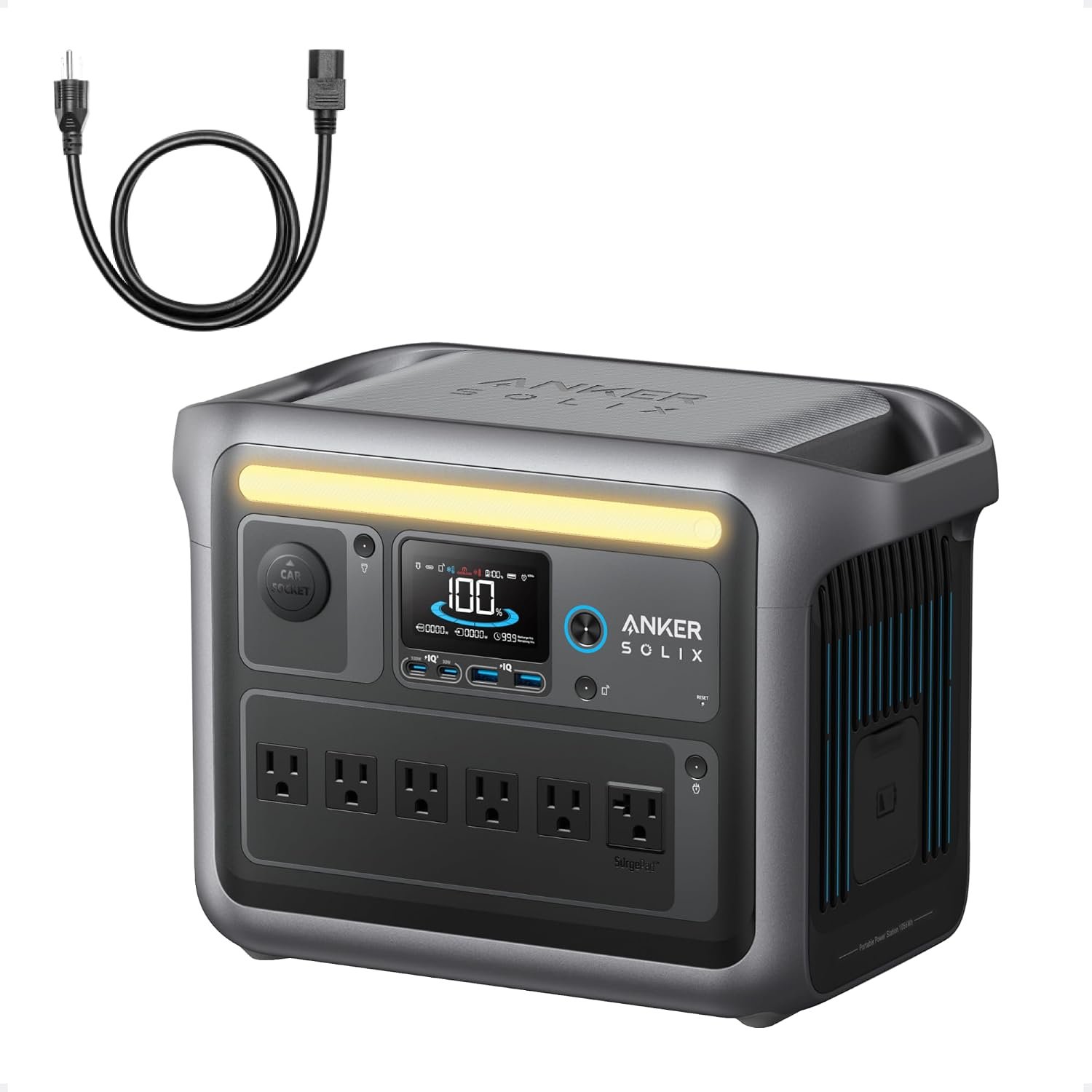
Anker SOLIX C1000 Portable Power Station
As an Amazon Associate I earn from qualifying purchases.
Losing access to electricity is inconvenient at the best of times. Whether it’s a temporary power cut at home, a camping trip or a day working somewhere without mains electricity, having a dependable source of portable power can make a considerable difference.
The Anker SOLIX C1000 Portable Power Station offers a practical solution, combining a 1056Wh lithium iron phosphate battery with 1800W continuous AC output, rapid recharging and intelligent app-based monitoring.
Unlike a traditional fuel-powered generator, it stores electricity in a rechargeable battery and delivers power through conventional outlets and USB connections.
That makes it useful for keeping essential electronics operating, charging devices and powering suitable appliances when a normal wall socket isn’t available.
For households interested in practical technology rather than unnecessary gadgets, the C1000 has an appealing combination of capability and convenience.
Why it works for home backup and outdoor power
The Anker SOLIX C1000 is built around a 1056Wh LiFePO4 battery.
Battery capacity is particularly important because it determines how much energy the power station can store.
A larger capacity generally allows equipment to operate for longer, although actual runtime depends on how much electricity connected devices consume.
The C1000 also provides 1800W continuous AC output through a pure sine wave inverter.
This allows it to power a variety of compatible household appliances, computers, chargers and other electrical equipment within its operating limits.
Anker’s SurgePad technology provides additional compatibility with certain appliances rated up to 2400W, although this shouldn’t be confused with a continuous 2400W output.
The power station is especially useful for temporary situations where running an extension cable from the house would be inconvenient or impossible.
It also offers an alternative to a conventional petrol generator for smaller backup-power requirements.
There is no fuel tank to fill, no engine to start and no exhaust produced during battery-powered operation.
However, the amount of stored energy remains finite, making sensible power management essential.
What it feels like to use
The Anker SOLIX C1000 has a compact, purposeful design.
Its dark grey housing, sturdy-looking construction and integrated carrying handles give it the appearance of equipment designed for practical use rather than decoration.
At approximately 28.4 pounds, or 12.9 kilograms, it has a substantial weight.
It is portable in the sense that one person can move it between locations, but it isn’t something most people would want to carry for extended distances.
The housing measures approximately 14.8 inches wide, 8.1 inches deep and 10.5 inches high.
That makes it manageable for storage in a utility room, vehicle or suitable camping setup.
The front panel brings together the display, power controls and several electrical connections.
A built-in screen provides information about the remaining battery charge, input power and electricity being supplied to connected devices.
This is particularly useful when deciding whether to continue operating an appliance or conserve battery capacity.
The physical controls are straightforward, while more detailed adjustments are available through the Anker smartphone app.
An integrated light also provides some useful illumination when working in poorly lit surroundings.
Overall, the design concentrates on accessibility and practical operation rather than complicated styling.
Eleven connections for everyday equipment
One of the C1000’s strongest features is its selection of power outlets.
The original American model provides six AC outlets, two USB-A connections, two USB-C connections and a 12V car-style output.
That offers considerable flexibility when several different devices need electricity.
For example, a laptop can use an appropriate AC or USB-C connection while smartphones and smaller accessories occupy other ports.
One USB-C port supports up to 100W, making it suitable for charging compatible higher-powered devices.
The second USB-C port provides up to 30W.
This flexibility is particularly valuable for people travelling with laptops, tablets, cameras and other rechargeable equipment.
However, all connected equipment shares the power station’s available capacity and operating limits.
The number of outlets doesn’t mean every connection can deliver maximum power simultaneously.
For a permanent home-office setup, our Anker Prime 250W Charging Station offers a different approach to managing several USB-powered devices.
The Prime is designed for everyday desktop charging using mains electricity, while the SOLIX C1000 provides stored battery power when a conventional outlet is unavailable.
Rapid recharging when time matters
Fast recharging is one of the most attractive features of the Anker SOLIX C1000.
Anker specifies that its UltraFast charging mode can replenish the battery from empty to full in approximately 58 minutes under suitable conditions.
It can also reach 80% capacity in approximately 43 minutes.
That is a substantial advantage when preparing for an unexpected power interruption or charging between outdoor activities.
Instead of leaving the unit connected for many hours, the C1000 can potentially recover a considerable amount of battery capacity during a relatively short period.
However, those figures depend on using the appropriate high-speed charging mode and suitable electrical conditions.
Anker recommends using normal charging where practical, reserving UltraFast charging for situations where speed is particularly important.
The smartphone app allows users to adjust the charging rate, providing some control over how much electricity the unit draws from a wall outlet.
That can be useful when sharing an electrical circuit with other equipment.
For people who prefer not to monitor charging constantly, the screen provides a convenient view of progress.
Solar charging for outdoor flexibility
The C1000 supports solar charging through a compatible photovoltaic input.
Anker specifies a maximum solar input of 600W.
Under favourable conditions, a suitable 600W solar-panel arrangement can recharge the battery in approximately 1.8 hours.
This is particularly interesting for camping, outdoor activities and temporary off-grid setups.
Solar charging provides a way to replenish stored electricity without relying entirely on access to mains power.
However, the solar panels are purchased separately unless specifically included in a bundle.
Actual charging performance depends heavily on sunlight, panel positioning, weather conditions and the electrical characteristics of the panels.
The power station also supports charging through a suitable vehicle connection.
The original C1000 package includes a car charging cable, making vehicle-based charging possible when used according to Anker’s instructions.
These charging options make the system considerably more adaptable than a simple rechargeable power bank.
For people interested in other practical connected equipment for outdoor living, our Rachio 3 Smart Sprinkler Controllerguide explores another way technology can simplify everyday tasks around the home and garden.
Smartphone monitoring and power management
The Anker SOLIX C1000 includes Wi-Fi and Bluetooth connectivity for use with the Anker app.
The app provides a way to monitor battery status, review power input and output, and adjust supported charging settings.
This is more useful than it might initially sound.
When operating several devices, knowing how much electricity each activity consumes can help prevent unexpected battery depletion.
Someone working remotely might discover that a laptop and external monitor use considerably less power than a small heating appliance.
Understanding those differences makes it easier to prioritise essential equipment.
The ability to adjust charging behaviour is also useful when preparing for a trip or planning how to use available electricity.
Households interested in examining electricity consumption more broadly may also appreciate our Emporia Vue 3 Energy Monitor guide.
The Emporia focuses on monitoring household electrical circuits, while the Anker concentrates on storing and supplying portable electricity.
Both illustrate how useful energy information can lead to more informed decisions.
LiFePO4 battery technology and long-term use
The C1000 uses lithium iron phosphate battery cells, commonly called LiFePO4 or LFP.
This battery chemistry is widely used in equipment where durability and cycle life are important.
Anker specifies approximately 3000 charge cycles before the battery reaches 80% of its original capacity under stated conditions.
That doesn’t mean the battery suddenly stops working after 3000 cycles.
Instead, it provides an indication of how battery capacity may change through repeated charging and discharging.
For someone using the power station regularly, long-term battery durability is an important consideration.
The system also supports an optional expansion battery, allowing total storage capacity to increase to approximately 2112Wh.
That expansion battery must be purchased separately.
Anker provides a five-year limited warranty for the C1000, subject to its applicable terms.
These features make the power station a more substantial proposition than an ordinary portable phone charger.
The drawbacks
Although the Anker SOLIX C1000 offers impressive capabilities, there are several limitations worth understanding before relying on it for backup power or outdoor electricity.
The most important drawback is its finite battery capacity.
The 1056Wh specification refers to stored battery energy rather than the amount of electricity guaranteed to reach connected appliances.
Some energy is lost during conversion from the internal battery to AC output.
The inverter and internal electronics also consume electricity during operation.
Consequently, usable energy at a wall-style outlet will be lower than the nominal battery capacity.
An appliance drawing substantial power can empty the battery relatively quickly.
A low-power light or laptop may operate for considerably longer than a portable heater, kettle or other energy-intensive appliance.
This distinction matters because the C1000’s 1800W continuous output rating can make it appear capable of running large appliances for extended periods.
It may be able to operate a suitable high-powered appliance, but doing so can consume its stored energy rapidly.
It isn’t a complete whole-home backup system.
The C1000 can supply electricity to compatible devices connected directly to its outlets.
It isn’t designed to replace the electrical supply to an entire house.
Homeowners wanting to operate central air conditioning, electric water heaters, large cooking appliances or other substantial household loads may require a much larger backup system.
The C1000 is better suited to selected essential equipment and temporary power requirements.
It should never be connected directly to household wiring or a generator inlet through an improvised cable. Any connection to home electrical circuits requires appropriate approved equipment and professional installation.
The weight is another significant consideration.
At approximately 28.4 pounds, the C1000 isn’t especially light.
Carrying it from a utility room to a vehicle is manageable for many adults, but moving it across uneven ground or over long distances may become tiring.
The integrated handles improve practicality, although they don’t eliminate the weight.
Anyone looking for an ultralight camping power supply may find a smaller battery station more suitable.
Fast charging has practical limitations.
The advertised 58-minute charging time depends on activating UltraFast mode and having suitable electrical conditions.
It isn’t necessarily the time every user will experience during ordinary charging.
High-speed recharging can also place a substantial load on the electrical circuit.
Anyone using the C1000 in a location with limited available power needs to consider what other equipment is operating.
Anker recommends normal charging when rapid recharging isn’t necessary.
The ability to charge quickly is valuable, but it shouldn’t be treated as an advantage that must be used during every charging session.
Solar charging requires additional equipment and suitable weather.
The C1000 supports up to 600W solar input, but compatible solar panels are not automatically included with every package.
Panels, suitable connectors and a practical installation area must all be considered.
Solar production changes throughout the day.
Cloud cover, shading, panel angle and seasonal sunlight can reduce charging performance substantially.
The manufacturer’s fastest solar-charging figures are therefore best regarded as favourable-condition estimates rather than guaranteed everyday results.
A campsite beneath trees, for example, may provide a pleasant setting but poor solar exposure.
Solar charging adds welcome flexibility, although it cannot guarantee a full recharge whenever electricity is needed.
SurgePad output isn’t the same as continuous output.
Anker advertises compatibility with certain appliances rated up to 2400W through its SurgePad technology.
However, the power station’s conventional continuous AC output remains 1800W.
SurgePad achieves its additional compatibility by adjusting electrical output, which may not suit every appliance.
Equipment containing sensitive electronics, precision controls or motors with particular operating requirements may not function as expected.
Buyers should check the electrical specifications of their intended appliances rather than relying entirely on the advertised maximum figure.
It is especially important to consider the starting requirements of motors and compressors.
The UPS function has limitations.
The C1000 provides an uninterruptible power supply function with a transfer time of approximately 20 milliseconds.
This can be useful for certain connected electronics when mains electricity fails.
However, it isn’t the same as a zero-transfer online UPS.
Some sensitive equipment may shut down or restart during the switchover.
Anyone protecting critical computer systems, network equipment or other sensitive electronics should verify the equipment’s tolerance for the specified transfer time.
The C1000 should not be relied upon as the sole power source for life-support or other safety-critical medical equipment.
It isn’t weatherproof.
Although the housing looks robust, the power station should not be treated as equipment that can be left exposed to rain or standing water.
Outdoor use requires suitable protection from moisture, excessive heat and environmental conditions outside Anker’s specified operating limits.
The charging temperature range is also important.
Anker specifies a minimum charging temperature of 32°F, or 0°C.
That means attempting to recharge the battery in freezing conditions is not appropriate.
Cold-weather camping and winter emergency use therefore require additional planning.
Battery expansion is an additional expense.
The ability to double capacity using a compatible expansion battery is useful.
However, the expansion battery isn’t included with the standard C1000.
Anyone expecting extended backup runtime needs to account for that additional equipment.
The expansion also increases the overall weight and the amount of space required.
For some households, choosing a larger power station from the beginning may be more appropriate.
App connectivity introduces another layer of complexity.
The physical controls and display allow essential functions without depending entirely on a phone.
However, more detailed settings and connected features require the Anker app.
Initial configuration, firmware updates and changing smartphone compatibility may introduce occasional inconvenience.
Users who prefer electrical equipment that operates entirely independently of wireless connections may find the connected features unnecessary.
There is also the long-term consideration of continued software support.
A power station may remain physically capable for years while its app-based features depend on ongoing manufacturer maintenance.
It requires sensible storage and battery maintenance.
Although LiFePO4 technology provides a useful cycle-life specification, the battery still needs appropriate care.
Anker recommends storing the unit in a cool, dry location, checking its charge level regularly and periodically recharging it during prolonged storage.
Leaving the power station forgotten in a garage for several years isn’t a sensible emergency-preparedness strategy.
Anyone intending to keep it available for unexpected outages should establish a routine for checking its condition and battery level.
Amazon’s return restrictions deserve particular attention.
The Amazon listing selected for this article indicates that the product is non-returnable because of transportation restrictions.
This is an important difference from buying a smaller consumer electronic accessory with an ordinary return arrangement.
Large lithium batteries can be subject to special transportation rules, particularly when shipping damaged or defective products.
Non-returnable status doesn’t necessarily remove applicable warranty rights or remedies for defective goods, but the procedures may be different.
Buyers should check the current Amazon listing, seller arrangements and Anker warranty terms before purchasing.
For equipment of this size and value, understanding what happens if the unit arrives damaged or develops a fault is particularly important.
Finally, the C1000 may be more power station than some households need.
Someone who only wants to recharge a smartphone during an occasional power cut may find a conventional power bank considerably easier to store and carry.
The C1000 makes more sense when there is a genuine requirement to power several devices or operate suitable AC equipment away from mains electricity.
Its useful features come with additional weight, storage requirements and complexity.
Choosing the right capacity for the intended task matters more than simply selecting the highest output rating available.
Who it suits best
The Anker SOLIX C1000 is particularly suitable for homeowners who want temporary backup electricity for selected essential devices.
It may also appeal to campers, RV owners, photographers, remote workers and people who regularly use electronics away from conventional power outlets.
The combination of AC sockets, USB connections, solar charging and smartphone monitoring provides useful flexibility for those situations.
Households that experience occasional electricity interruptions may appreciate having a rechargeable power source ready for compatible communications equipment, lighting and smaller appliances.
However, anyone needing whole-home backup, very long high-power runtime or an ultralight travel charger should consider alternatives.
For more practical connected devices and useful household technology, explore our Home Tech & Appliances guides.
Is it worth making room for?
The Anker SOLIX C1000 offers a convincing combination of battery capacity, practical output connections and intelligent power management.
Its 1056Wh LiFePO4 battery, 1800W continuous output, rapid charging capability and solar compatibility make it useful for a variety of situations where mains electricity is unavailable.
The compact design, informative display and connected monitoring features add convenience without removing the essential physical controls.
There are important compromises.
Its weight is noticeable, demanding appliances can exhaust the stored energy quickly, and solar charging requires additional equipment and suitable conditions.
The UPS limitations and Amazon return restrictions also deserve careful consideration.
Nevertheless, for people who genuinely need reliable portable electricity for appropriate equipment, the original Anker SOLIX C1000 is a capable and thoughtfully designed power station.
Its appeal comes from offering useful electricity when and where it is needed, without the complications associated with a traditional fuel-powered generator.
As an Amazon Associate I earn from qualifying purchases.