
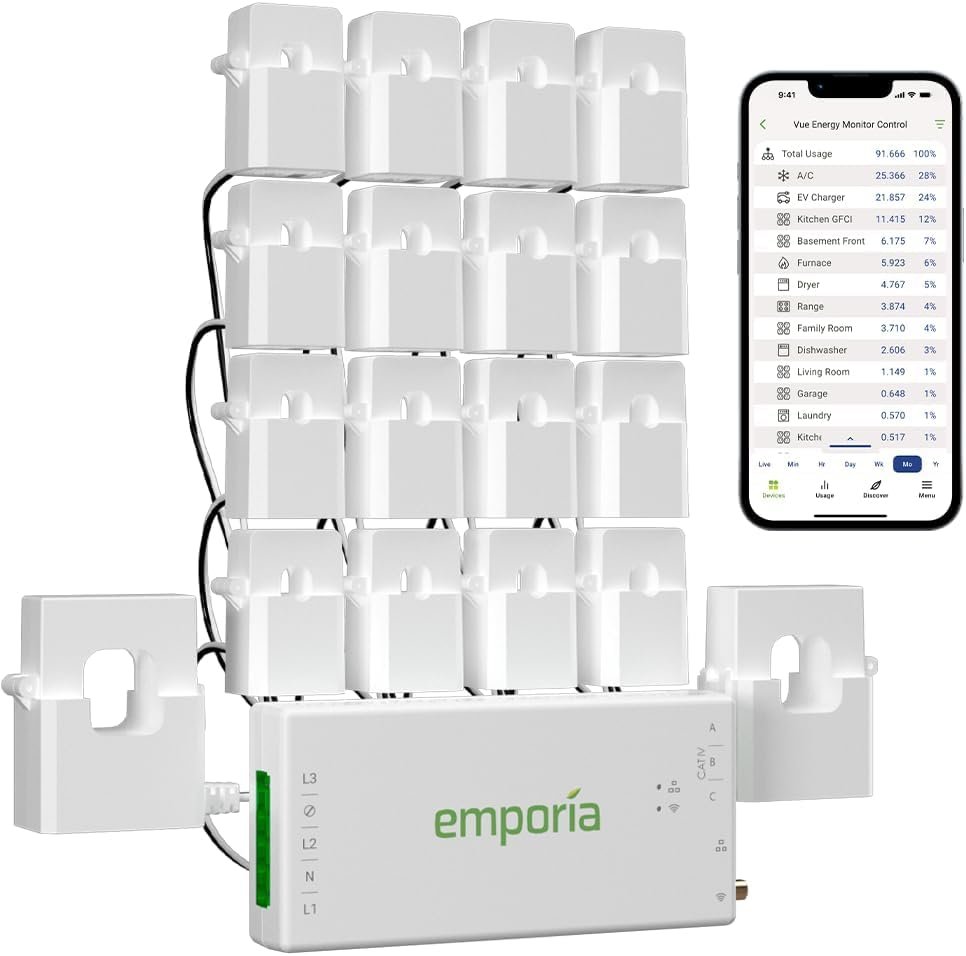
Emporia Vue 3 Energy Monitor
As an Amazon Associate I earn from qualifying purchases.
The Emporia Vue 3 Energy Monitor offers something many households have never had: a clearer picture of where their electricity actually goes.
Most people receive an electricity bill showing how much energy they have consumed, but very little information about which appliances or circuits were responsible.
The Emporia Vue 3 approaches that problem through intelligent monitoring.
Installed inside a compatible electrical panel, it measures household electricity consumption and sends detailed information to a connected smartphone app.
The 16-sensor version can monitor up to 16 individual branch circuits alongside overall household consumption, helping homeowners identify where electricity is being used throughout the day.
For anyone interested in understanding their home’s energy habits, this is practical technology with a clear purpose.
However, the Vue 3 is not an ordinary plug-in smart-home accessory. Installation involves electrical work, and its dependence on cloud connectivity introduces important considerations.
Why It Works in a Smart Home
The most useful feature of the Emporia Vue 3 is its ability to turn electricity consumption into understandable information.
A conventional electricity bill provides a total figure for a billing period.
It doesn’t ordinarily explain how much energy was consumed by the air conditioning, water heater, laundry equipment or other household systems.
The Vue 3 provides a more detailed picture.
Its main current sensors monitor electricity flowing through the household supply, while the additional sensors measure selected individual circuits.
This makes it possible to identify patterns that would otherwise remain hidden.
For example, a homeowner might discover that an electric water heater operates more frequently than expected.
Another household might notice unusually high consumption during the night.
These observations don’t automatically mean something is wrong, but they provide useful information for deciding what deserves further investigation.
Rather than guessing which equipment uses the most electricity, homeowners can begin making decisions based on measured consumption.
Monitoring Up to 16 Individual Circuits
The version selected for this article includes 16 branch-circuit current sensors.
These allow the system to monitor electricity flowing through individual circuits in a compatible distribution panel.
That is particularly useful because many important household appliances are connected to dedicated circuits.
An electric water heater, clothes dryer or air-conditioning system may have its own circuit, making its consumption easier to identify.
The Vue 3 uses current transformers, commonly called CT sensors, to measure electrical current.
The main sensors monitor overall consumption, while the smaller sensors provide more detailed circuit information.
Emporia specifies measurement accuracy of approximately ±2% under its stated conditions.
For ordinary household monitoring, that provides a useful level of detail.
However, an important distinction is worth understanding.
The Vue measures circuits rather than recognising every individual appliance connected to them.
If several lights, outlets and appliances share one circuit, the system generally measures their combined consumption.
It cannot automatically identify each device simply because it is connected to that circuit.
For detailed appliance-level monitoring, additional equipment or a dedicated circuit may be necessary.
Real-Time Electricity Information
One of the Vue 3’s more interesting capabilities is its high-resolution monitoring.
Emporia supports data reporting at intervals as short as one second.
That makes it possible to observe changes in electricity demand when connected equipment switches on or off.
For example, starting a large electrical appliance may produce an obvious increase in the measured load.
When the appliance finishes its operating cycle, consumption should reduce accordingly.
These changes can help homeowners understand how equipment behaves throughout the day.
The app also provides historical consumption information, allowing users to examine broader patterns rather than focusing entirely on instantaneous readings.
Daily and monthly trends are often more useful for understanding household energy habits.
An occasional short increase in electrical demand may have relatively little effect on overall consumption.
Equipment that operates for many hours can have a much greater influence.
That distinction is one reason detailed monitoring can be useful.
What It Feels Like to Use
Unlike many smart-home products, the Emporia Vue 3 is not designed to be displayed on a shelf or kitchen counter.
The monitoring unit and sensors are installed within the electrical panel, subject to the manufacturer’s clearance and installation requirements.
Once professionally installed, the equipment remains largely out of sight.
The everyday experience centres on the Emporia smartphone app.
Instead of interacting with the hardware, users examine electricity consumption through graphs and individual circuit readings.
This can be particularly interesting during the first few weeks.
Ordinary household activities begin to reveal recognisable patterns.
Cooking, heating water, running laundry equipment and using air conditioning can all contribute to changing electrical demand.
Over time, these readings become more meaningful as the homeowner develops a clearer understanding of normal consumption.
The technology is most valuable when the information leads to practical decisions rather than simply providing another collection of numbers.
Smart Alerts and Energy Awareness
The Emporia system supports configurable notifications and energy-related alerts.
These can help homeowners identify unusual operating patterns or equipment that appears to be consuming electricity unexpectedly.
For example, monitoring may reveal that a connected load continues running longer than anticipated.
The owner can then investigate whether the behaviour is normal.
The app also supports energy-management features that can work alongside compatible Emporia equipment.
Depending on the wider installation, these may include smart plugs and electric vehicle charging equipment.
This creates opportunities to combine monitoring with automated control.
However, the Vue 3 itself is primarily a monitoring device.
It doesn’t automatically switch off every appliance connected to the household electrical panel.
Actual control depends on having compatible devices and configuring the appropriate functions.
That distinction matters when deciding what the system can realistically achieve.
Useful for Solar-Powered Homes
The Vue 3 can also support monitoring of solar electricity production and net energy consumption.
For households with suitable solar installations, this provides another useful source of information.
Understanding when solar generation is strongest can help homeowners plan certain electricity-consuming activities.
Running flexible loads during periods of available solar generation may improve the household’s use of its own generated electricity.
However, results depend on the solar system, electricity tariff, export arrangements and the home’s existing consumption patterns.
The Vue must also be configured correctly for the electrical installation.
Solar monitoring is a useful capability, but it shouldn’t be assumed to work identically with every installation without checking compatibility.
How It Fits With Other Smart Home Technology
The Emporia Vue 3 focuses on understanding electricity consumption.
Other connected-home devices approach household efficiency from different directions.
For example, our guide to the ecobee Smart Thermostat Premium explores technology designed to manage heating and cooling through connected controls and room sensing.
The ecobee actively controls compatible climate equipment, while the Vue helps users examine the electricity consumed by monitored circuits.
The two serve different purposes, but both contribute to a more informed approach to managing a home.
Another example is the Airthings View Plus Air Quality Monitor.
The Airthings monitors indoor environmental conditions rather than electrical consumption.
Together, these products illustrate how smart-home technology can provide useful information about different aspects of everyday living.
The important consideration is whether that information helps the homeowner make meaningful decisions.
The Drawbacks
The Emporia Vue 3 provides detailed electricity monitoring, but there are several important limitations.
Some concern the installation itself, while others involve the connected software and how the information should be interpreted.
Professional Installation Is Strongly Recommended
This is the most significant consideration.
The Vue 3 requires installation inside an electrical distribution panel, where dangerous voltages may be present.
Emporia’s installation guide specifies that the work should be carried out by a skilled person, such as a licensed electrician or other appropriately qualified professional, in accordance with local electrical regulations.
Even when the main breaker is switched off, parts of an electrical panel may remain energised.
Improper installation can cause serious injury or death.
This is not a suitable project for an inexperienced homeowner.
Professional installation also adds an expense and requires arranging access to the electrical panel.
Anyone considering the Vue should account for that work before purchasing.
Not Every Electrical Panel Is Suitable
The Vue 3 supports several common electrical supply configurations, but compatibility cannot be assumed.
The electrical panel must provide suitable space for the monitoring unit, current sensors and associated wiring.
Crowded panels may present difficulties.
Certain supply arrangements may also require additional equipment or may not be supported.
A qualified electrician should examine the panel type, available space and electrical configuration before installation.
This is particularly important in older properties or homes with unusual electrical systems.
The monitoring equipment should never obstruct protective devices or interfere with the safe operation of the panel.
It Requires an Internet Connection
The Vue 3 depends on internet connectivity for its principal monitoring features.
It supports 2.4GHz Wi-Fi and wired Ethernet connections.
However, connecting the hardware to a local network doesn’t provide a fully independent local monitoring system.
Emporia relies on its cloud platform for app functionality, data storage and software updates.
If the internet connection becomes unavailable, users cannot expect the same live monitoring experience.
That may be frustrating for households in areas with unreliable broadband.
Anyone specifically wanting completely local energy monitoring should consider this limitation carefully.
Energy Data Is Stored in the Cloud
The Vue 3 does not currently provide local data storage as a standard feature.
Consumption information is sent to Emporia’s cloud infrastructure.
This allows remote access and convenient historical monitoring, but it also creates dependence on an external service.
People concerned about privacy may prefer equipment that stores electricity information entirely within their own network.
There is also the longer-term question of continued platform support.
Connected products depend on software maintenance, account access and the manufacturer’s ongoing operation of its services.
The Vue’s hardware may remain physically functional for years, but its connected experience depends on that wider infrastructure.
Sixteen Sensors May Not Cover Every Circuit
The 16-sensor package offers extensive monitoring, but some homes have considerably more than 16 branch circuits.
In those properties, users must decide which circuits are most important to measure.
The system can still monitor overall household consumption, but it won’t provide individual readings for every unmonitored circuit.
Emporia supports combining multiple Vue monitors within the app when additional coverage is needed.
That introduces further hardware, installation work and configuration.
For a large property with several electrical panels, the overall monitoring system can become more involved than the original package suggests.
Circuit Monitoring Isn’t Individual Appliance Recognition
A circuit sensor measures the electricity flowing through the monitored conductor.
It doesn’t automatically distinguish every appliance sharing that circuit.
For example, several kitchen outlets may be connected to one branch circuit.
If a kettle, toaster and coffee machine operate on that circuit, their consumption contributes to the same measured total.
The Vue may show when demand increases, but identifying the precise appliance responsible can still require observation.
This limitation is important for anyone expecting a detailed breakdown of every household device without additional equipment.
Energy Savings Are Not Guaranteed
The ability to measure electricity consumption does not automatically reduce it.
The Vue can show where energy is being used, but homeowners must decide whether changes are practical.
Some appliances consume substantial electricity because they perform necessary functions.
An electric water heater or heating system, for example, cannot simply be switched off whenever consumption increases.
Actual savings depend on existing household habits, equipment efficiency, available alternatives and electricity tariffs.
The monitor is best understood as an information tool.
Its value comes from helping people identify realistic opportunities rather than promising automatic reductions in their bills.
Measurements May Differ From Utility Billing
Emporia specifies approximately ±2% monitoring accuracy under its stated conditions.
That is useful for examining trends and comparing circuits, but it doesn’t mean the Vue will always match a utility company’s billing meter exactly.
Differences may arise from measurement conditions, installation configuration, timing and data calculations.
Cost estimates also depend on how electricity tariffs are configured in the app.
Homes with complicated time-of-use tariffs, standing charges or unusual billing arrangements may need additional attention to produce meaningful estimates.
The Vue should not be regarded as a replacement for the utility company’s official billing equipment.
Panel Space and Sensor Wiring Need Planning
The monitoring unit itself is compact, but a 16-sensor installation involves numerous sensor leads.
These must be positioned safely inside the electrical panel.
In a spacious, modern panel, that may be relatively straightforward for a qualified installer.
In a crowded installation, arranging the monitoring equipment without interfering with existing components can be more challenging.
The physical installation deserves careful planning rather than assuming that compact electronics always mean simple fitting.
Long-Term Dependence on Connected Technology
The Vue 3 is more sophisticated than an ordinary electricity meter.
That sophistication brings reliance on firmware, app compatibility and the continued availability of Emporia’s software platform.
Smartphone operating systems and connected services change over time.
Although software updates can provide improvements, they may also change the way features operate.
For someone who prefers equipment that functions independently without accounts or cloud services, this is a meaningful disadvantage.
The Vue makes the most sense for households comfortable with connected technology and its ongoing requirements.
Who It Suits Best
The Emporia Vue 3 is particularly suitable for homeowners who want a better understanding of their electricity consumption.
It should appeal to households with several significant electrical loads, including electric water heating, air conditioning, laundry equipment and electric vehicle charging.
People with suitable solar installations may also appreciate its production and consumption monitoring.
The system is particularly useful for anyone who enjoys examining data and using that information to make practical changes.
However, it is less appropriate for people who want a simple plug-in device, cannot arrange suitable professional installation or require completely local monitoring.
For more useful connected-home equipment, explore our Smart Home & Security collection.
Is It Worth the Installation Space?
The Emporia Vue 3 Energy Monitor offers a genuinely useful approach to understanding household electricity consumption.
Its combination of whole-home monitoring, 16 individual circuit sensors, real-time data and connected app features provides information that ordinary electricity bills cannot easily supply.
The hardware also remains largely hidden once properly installed, avoiding additional clutter in living areas.
Nevertheless, professional installation, electrical panel compatibility and cloud dependence are significant considerations.
The system won’t automatically make a household more efficient, and its readings require interpretation.
For homeowners prepared to use the information constructively, however, the Vue 3 provides a practical way to understand energy consumption and identify areas that may deserve attention.
Its greatest strength isn’t simply collecting electrical data. It’s making that information useful enough to support better everyday decisions.
As an Amazon Associate I earn from qualifying purchases.