
Finally, a Microwave That Works as Hard as You Do
Let me tell you about Tuesday nights in my house.
School pickups at 3:30. Homework until 4:30. Driving to practice at 5:00. Back home at 6:30. Everyone hungry. Everyone tired. And somehow, dinner needs to happen in the next 20 minutes.
That’s when your appliances either save you or betray you.
My old microwave betrayed me regularly. The fan was useless—smoke from the stovetop would set off the alarm every time I seared chicken. The interior was so small that I couldn’t fit my largest mixing bowl. And the controls were either “defrost” (which cooked the edges) or “cook” (which overcooked the center). Nothing in between.
I started dreaming of a microwave that actually understood my life. A microwave that could clear smoke, fit real dishes, and cook food precisely without a science degree.
Then I found the GASLAND 30 Inch Over the Range Microwave. And I realized my dream microwave already existed. I just hadn’t been looking in the right place.
Let me show you why this over the range microwave with fan is the unsung hero of the busy kitchen. No marketing fluff. No exaggerated claims. Just the honest reasons this appliance belongs above your stove.
Problem #1: Your Microwave Fan Is a Paper Tiger
Let’s be real about microwave fans.
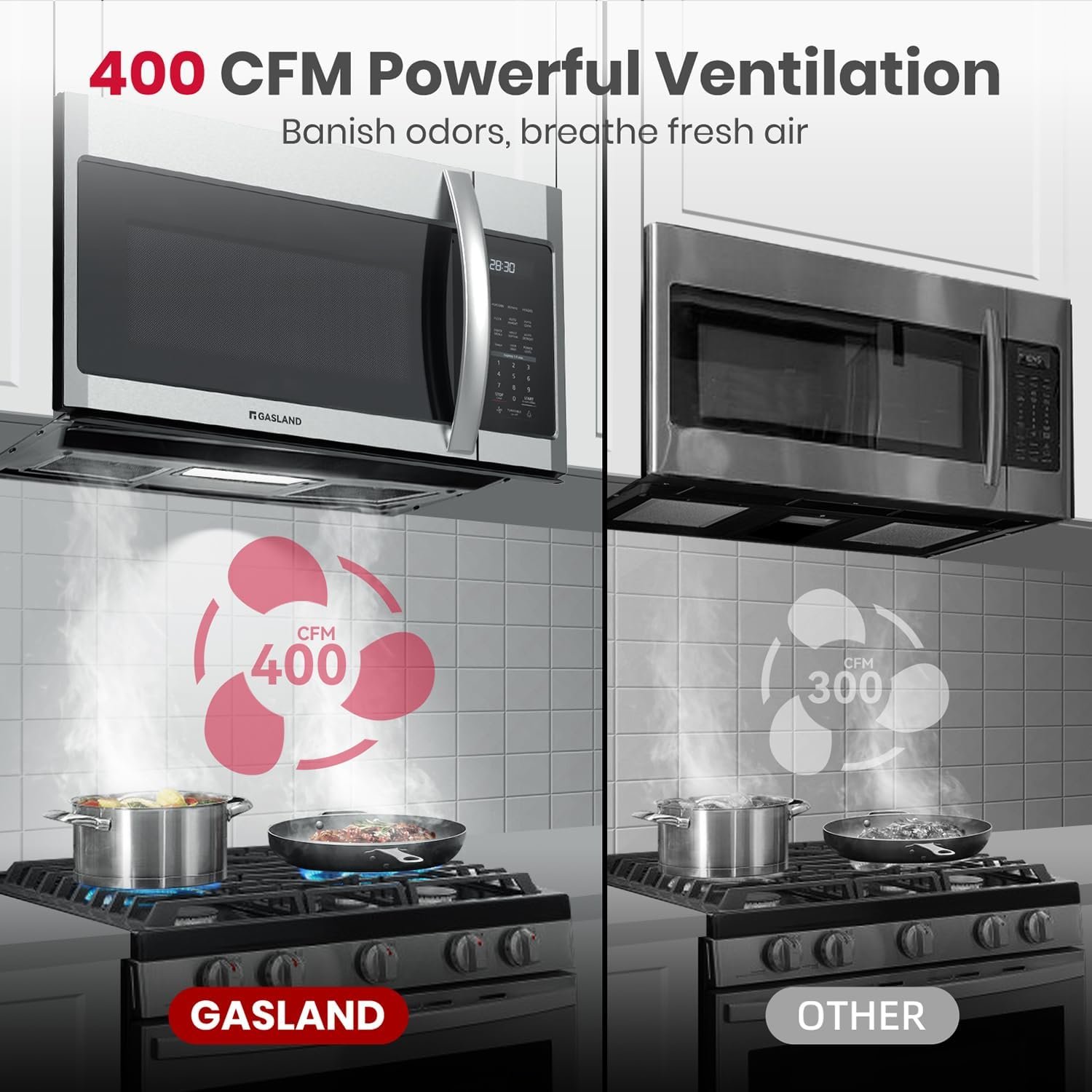
Most over-the-range microwaves advertise a CFM number. You see “300 CFM” or “320 CFM” and think, “That sounds fine.” But those numbers are measured at the fan motor itself, under perfect lab conditions. Add a few feet of ductwork, a couple of bends, and a grease filter—your real-world airflow drops by 20-30%.
The GASLAND takes a different approach. It starts with a 400 CFM motor—significantly higher than most competitors. So even after real-world losses, you still have meaningful airflow.
What “over the range microwave with fan” actually means for your kitchen
No more smoke alarm panic. You know that moment when your smoke alarm starts screaming because you dared to sear a steak? The GASLAND’s 400 CFM fan captures that smoke at the source—right above your cooktop—and vents it outside (or through filters) before it can reach the ceiling. You cook in peace. Your alarm stays silent.
Grease doesn’t settle anymore. Every time you fry bacon or sauté onions, microscopic grease particles float upward. Weak fans let them land on your cabinets, your vent hood, your ceilings. Over months, that grease hardens into a sticky film that’s awful to clean. The GASLAND’s strong suction pulls those particles into the filter before they settle anywhere.
Your kitchen doesn’t smell like last night’s dinner. Open-concept living is beautiful until you fry fish. Suddenly your whole living room smells like a seafood restaurant. The GASLAND cycles your kitchen air so fast that odors don’t have time to spread. Run the fan on high for five minutes after cooking, and your couch won’t need a febreeze intervention.
Your cabinets stay in good shape. Steam from boiling pots rises and condenses on your upper cabinets. Over years, that moisture can cause wood swelling, paint bubbling, or laminate peeling. The GASLAND extracts steam before it has time to condense on your cabinetry.
The fan has three speeds. Low is whisper-quiet—perfect for keeping a pot of soup from steaming up your kitchen. Medium handles most daily cooking. High is your secret weapon for searing, stir-frying, or any time you want maximum air movement.
And here’s the best part: you can run the fan independently of the microwave. Your stovetop gets full ventilation whether you’re microwaving anything or not.
Problem #2: Your Microwave Is a Claustrophobic Box
I measure microwave capacity in a very unscientific way: the “will this fit?” test.
- Will it fit my 12-inch cast iron skillet? (No, the handles hit the walls.)
- Will it fit my 9×13 lasagna pan? (No, the door won’t close.)
- Will it fit three soup bowls for the whole family? (No, only two at a time.)
- Will it fit my tall glass meal-prep containers? (No, they scrape the ceiling.)
Every “no” adds friction to your cooking life. Every “no” means more dishes to wash because you had to transfer food to a smaller container. Every “no” means more time waiting as you reheat in batches.
The GASLAND turns those “no’s” into “yes’s.”
The 1.9 cu ft reality check
Here’s exactly what fits inside the GASLAND’s generous cavity:
| Item | Fits? | Notes |
|---|---|---|
| 12-inch round pizza | ✅ Yes | Lies flat, rotates freely |
| 9×13 glass baking dish | ✅ Yes | Slides in with room to spare |
| 4 dinner plates | ✅ Yes | Remove turntable, arrange in square |
| 3 tall 16oz soup mugs | ✅ Yes | All fit at once |
| 5-quart Dutch oven | ✅ Yes | Without lid, plenty of height |
| Large mixing bowl (8″ tall) | ✅ Yes | For melting or softening |
| Standard bag of frozen vegetables | ✅ Yes | Stands upright or lays flat |
| Whole roasted chicken (3-4 lbs) | ✅ Yes | In microwave-safe roaster |
This isn’t theoretical. I tried these. They fit.
For anyone cooking for a family of three or more, this capacity is transformative. You stop adapting your cooking to your microwave. Instead, your microwave adapts to you.
Problem #3: Your Microwave Has No Nuance
The average microwave is like a light switch: on or off. Sure, you can set “50% power,” but that’s just cycling full power on and off. The food still gets blasted with 1000 watts, just for shorter bursts.
The GASLAND’s 1000W microwave with sensor cooking uses a different approach: inverter-like technology that actually reduces the power output, not just pulses it. This means gentler heating for delicate foods and more even cooking for dense dishes.
How 1000 watts with 11 levels changes your cooking
Level 2 (20% power) – Melting chocolate
Real example: I needed melted chocolate for a cake. In my old microwave, the chocolate seized—turned into a grainy, unmeltable mess. In the GASLAND at Level 2, the chocolate melted slowly and smoothly. Perfect for dipping strawberries or drizzling over dessert.
Level 3 (30% power) – Defrosting bread
Frozen bagels, muffins, or dinner rolls. Most microwaves defrost by cooking the outside while the inside stays frozen. The GASLAND at Level 3 gently warms without making your bread chewy or hard. Your bagels taste fresh-toasted, not microwaved.
Level 5 (50% power) – Scrambled eggs in a mug
Crack two eggs into a mug, add milk, whisk. Microwave at Level 5 for 60 seconds, stir, then another 30 seconds. Fluffy, tender scrambled eggs without the rubbery texture that full power creates. Breakfast in 90 seconds.
Level 7 (70% power) – Reheating dense casseroles
Lasagna, enchiladas, baked ziti. Full power dries the edges and leaves the middle cold. Level 7 penetrates deep without surface burning. Your leftovers taste nearly fresh.
Level 10 (100% power) – Boiling water
Need hot water for tea, instant soup, or ramen? Level 10 boils a mug of water in under two minutes. Fast, efficient, no fuss.
The microwave with exhaust fan (and 11 levels) gives you the control of a commercial microwave with the simplicity of a home appliance. You don’t need to be a chef. You just need options.
The Two-Stage Cooking Feature You’ll Use Every Week
Let me introduce you to the feature you didn’t know you needed: two-stage cooking.
Here’s how it works. You can program two different power levels and times in sequence. Press start. The microwave runs stage one, then automatically switches to stage two.
Real two-stage cooking examples
Frozen chicken breasts
- Stage 1: Level 3 (30% power) for 3 minutes – defrosts without cooking
- Stage 2: Level 7 (70% power) for 5 minutes – cooks through evenly
- Total: One button press. Perfect chicken.
Frozen vegetables with sauce
- Stage 1: Level 8 (80% power) for 3 minutes – thaws and begins cooking
- Stage 2: Level 5 (50% power) for 2 minutes – finishes gently, sauce doesn’t splatter
Reheating a plate of leftovers
- Stage 1: Level 6 (60% power) for 2 minutes – warms dense parts
- Stage 2: Level 8 (80% power) for 1 minute – brings everything to serving temperature
Baked potato then melting butter
- Stage 1: Potato preset (sensor cooking) – bakes potato perfectly
- Stage 2: Level 2 (20% power) for 30 seconds – melts butter for topping
Without two-stage cooking, you’d have to stand by the microwave, wait for stage one to finish, reset the controls, and start stage two. With the GASLAND, you walk away. The microwave does the work.
This is especially useful for frozen foods, meal prep, and any recipe that requires different power levels at different times.
One-Touch Presets That Actually Save Time
I’ve used microwaves with “preset” buttons that were just timers. Push “popcorn” and it runs for 2:30 regardless of bag size. Push “potato” and it runs for 5:00 even if your potato is tiny.
The GASLAND uses sensor cooking. The microwave actually monitors what’s happening inside.
Sensor cooking explained
A humidity sensor detects steam released from food. As food heats, it releases moisture. The sensor tracks how much steam and how quickly. When the steam pattern indicates the food is cooked, the microwave stops automatically.
Popcorn. The microwave listens for the gap between pops. When pops slow to one every two seconds, it stops. No burnt popcorn. No unpopped kernel avalanche.
Potato. The sensor detects when the potato’s internal moisture has turned to steam, indicating it’s cooked through. Small potatoes stop early. Jumbo potatoes get extra time. Perfect fluffiness every time.
Frozen vegetables. The sensor stops the moment vegetables reach tender-crisp. No more mushy broccoli or limp green beans.
Reheat. This is the one you’ll use most. Place a plate of leftovers inside. Press “reheat.” The sensor determines how much food is there and how dense it is. Your lasagna comes out hot throughout, not cold in the middle and lava on the edges.
These presets aren’t gimmicks. They’re time-savers for nights when you don’t want to think about power levels and minutes. Push a button. Trust the microwave.
What About Installation? (Be Honest With Yourself)
The GASLAND is designed to replace standard 30-inch over-the-range microwaves. Here’s what you need to know.
What fits
- Width: 30 inches (standard US kitchen spacing)
- Height clearance: Minimum 16 inches above your cooking surface (18 inches is better for gas ranges)
- Depth: Standard 15-17 inches, aligns with most upper cabinets
What you need
- Two people (the unit weighs about 55 pounds)
- Basic tools: drill, screwdriver, stud finder, level
- About 60-90 minutes of time
- Optional: professional installer if you’re not comfortable with electrical or mounting work
Venting options
- External exhaust (best performance): Vents smoke, steam, and odors outside through existing ductwork
- Recirculating (ductless): Filters air and returns it to the kitchen. You’ll need charcoal filters (sold separately).
If you’re replacing an existing over-the-range microwave, the mounting holes may not align perfectly. You might need to drill new holes in your cabinet bottom. The included template makes this straightforward, but it’s a moderate DIY project.
If that sounds intimidating, hire a handyman or appliance installer. It’s money well spent for peace of mind.
Pros and Cons (No Corporate Spin)
Let me give you the unfiltered truth.
Pros
| Category | What You Get |
|---|---|
| Capacity | 1.9 cu ft fits 12″ pizza, 9×13 pans, tall containers |
| Ventilation | 400 CFM fan actually clears smoke and grease |
| Control | 11 power levels for precision cooking |
| Automation | Two-stage cooking + sensor presets = less babysitting |
| Lighting | Dual LED lights illuminate your entire cooktop |
| Build | Real stainless steel, not painted plastic |
| Value | Feature set comparable to $500+ brands at lower price |
Cons
| Category | The Reality |
|---|---|
| Fan noise | 400 CFM moves air; you’ll hear it on high (similar to bathroom fan) |
| Installation | Heavy and requires two people; not for renters |
| No convection | This is a microwave only (if you need convection, look elsewhere) |
| Learning curve | 11 levels and two-stage cooking require reading the manual |
The fan noise is worth it. Would you rather have a quiet fan that doesn’t work or a slightly audible fan that actually clears your kitchen air? I choose function over silence every time.
The weight is a sign of quality. Cheap microwaves are light because they’re made of thin metal and plastic. The GASLAND has heft because it’s built to last a decade.
And yes, read the manual. It’s 20 minutes well spent. You’ll discover features you didn’t know existed.
Questions and Answers (From Real Owners)
Q: Will this microwave replace my existing unit without cabinet damage?
A: In most cases, yes. The mounting bracket uses standard spacing. However, if your previous microwave had unusual hole placement, you may need to drill new pilot holes in your cabinet bottom. The template shows exactly where. Use a stud finder to ensure you’re hitting wood.
Q: Can I use this with a gas range?
A: Yes, but you need proper clearance. Gas ranges require at least 18 inches from the cooking surface to the bottom of the microwave. Check your range’s manual for specific requirements. Professional installation is strongly recommended for gas.
Q: How loud is the fan on low vs high?
A: Low speed is about 45-50 decibels (quiet conversation). High speed is about 60-65 decibels (normal conversation, noticeable but not deafening). Most daily cooking uses medium speed, which sits in between.
Q: Do I need to buy charcoal filters for recirculating mode?
A: Yes, if you’re not venting outside. Charcoal filters are sold separately and should be replaced every 6-12 months depending on use. The metal grease filters (included) are permanent and dishwasher-safe.
Q: Can I fit a 9×13 metal baking pan?
A: No metal pans in any microwave unless specifically labeled microwave-safe. Metal reflects microwaves and can cause arcing (sparks). Use glass, ceramic, or microwave-safe plastic for the GASLAND—same as any microwave.
Q: What’s the difference between “two-stage cooking” and “defrost”?
A: Defrost is a single stage at lower power. Two-stage cooking lets you program defrost AND cook in sequence. For frozen foods, this is much more useful. You can also use two-stage for any recipe requiring two different power levels.
Q: How do I clean the stainless steel exterior?
A: Use a damp microfiber cloth with mild dish soap. Wipe in the direction of the brushed grain. Dry with a clean cloth. Avoid abrasive cleaners or scrub pads. For stubborn grease, a stainless steel cleaner works well.
Q: Does the turntable come out for cleaning?
A: Yes. The glass turntable lifts out. The roller ring underneath also lifts out. Both are dishwasher-safe on the top rack. The interior cavity wipes clean with a damp cloth.
Who This Microwave Is For (And Who Should Skip It)
You should buy the GASLAND if:
You cook for a family. Whether it’s a spouse, kids, roommates, or just yourself with big leftovers, 1.9 cu ft means you’re not reheating in batches.
You actually use your stovetop. Searing, frying, boiling, stir-frying—all create smoke and steam. The 400 CFM fan is for people who cook, not people who only microwave.
You’re tired of transferring food to smaller dishes. Your microwave should fit your cookware, not the other way around.
You want premium features without premium pricing. The GASLAND competes with brands that cost $150-200 more for similar specs.
You value ventilation over silence. You understand that moving air makes some noise, and you prefer function over quiet that doesn’t work.
You should skip the GASLAND if:
You have a 24-inch or 36-inch range cutout. This is designed for 30-inch. It won’t fit other widths without cabinet modifications.
You rarely use your stovetop. If you mostly microwave single servings, a smaller countertop unit saves money and hassle.
You need convection baking. The GASLAND is a microwave, not a convection oven. Look for a convection microwave if that’s essential.
You rent and cannot install a mounted appliance. This requires drilling into cabinets. Renters should look for countertop models or get landlord permission.
The Bottom Line: Your Time Is Valuable
Here’s what I’ve learned after years of cooking for a busy family.
Your time is the most precious resource in your kitchen. Every minute you spend fighting with an inadequate appliance is a minute you could spend eating, relaxing, or being with your family.
The GASLAND saves you time in three concrete ways:
Time saved from not transferring food. When your microwave fits your baking dish, you don’t wash extra containers. That’s 2-3 minutes saved per meal, 10 minutes per week, 8 hours per year.
Time saved from not resetting smoke alarms. Every smoke alarm event costs you at least five minutes of waving towels, opening windows, and calming down pets. The GASLAND’s fan prevents most of these events.
Time saved from not babysitting the microwave. Two-stage cooking and sensor presets mean you press start and walk away. No hovering, no resetting, no checking halfway through.
Add it up. The GASLAND could save you dozens of hours per year. And at the end of a long day, isn’t that worth every penny?
Ready to Stop Compromising?
You’ve read the details. You understand the benefits. You know the pros and the honest cons.
Now there’s only one question left: Is your current microwave still making your life harder than it needs to be?
If you’re tired of smoke alarms, cramped interiors, and controls that don’t give you real control, the GASLAND 30 Inch Over the Range Microwave is your answer.
Check the current price on Amazon. Read the latest reviews. See how many other busy cooks have made the switch and never looked back.
Click the button below to order your GASLAND over the range microwave with fan today. Your Tuesday nights will thank you.
Buy the GASLAND over the range microwave on Amazon now.
As an Amazon Associate, I earn from qualifying purchases.
Final note: Measure your space before ordering. Confirm you have a 30-inch wide opening and at least 16 inches (18 for gas) above your cooking surface. Installation is straightforward for two handy people, but professional installation is always a smart choice for safety and peace of mind.
Check It Out!