
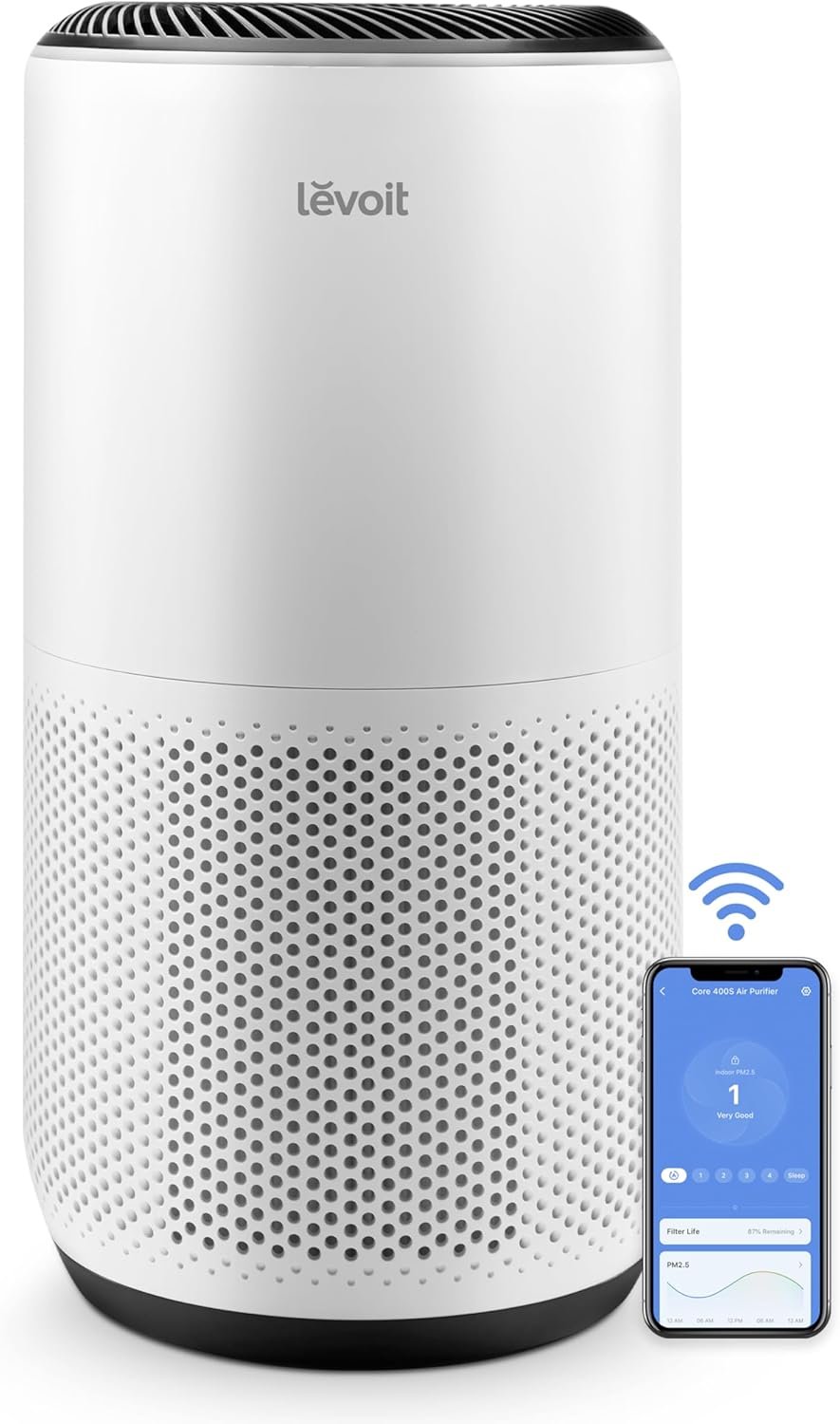
LEVOIT Core 400S-P Smart Air Purifier
As an Amazon Associate I earn from qualifying purchases.
The LEVOIT Core 400S-P Smart Air Purifier combines substantial air filtration with intelligent monitoring, automatic fan adjustment and convenient smart-home controls. Designed for living rooms, bedrooms and other frequently occupied spaces, it offers a practical way to reduce airborne particles without constantly adjusting the equipment.
Its three-stage filtration system captures particles such as household dust, pollen, pet dander and smoke particles, while a built-in laser sensor monitors changes in the surrounding air.
The Core 400S-P also connects to the VeSync smartphone app, allowing homeowners to adjust settings, create schedules and monitor air-quality information remotely.
With its understated white housing, cylindrical shape and black upper grille, it has a contemporary appearance that should fit comfortably into many modern interiors.
What makes this purifier particularly interesting is the combination of useful filtration performance and connected technology. It can respond to changing particle levels automatically rather than relying entirely on the owner to select the appropriate fan speed.
However, understanding its room coverage, filter maintenance and limitations is important before deciding whether it deserves a permanent place in the home.
Why It Works in a Smart Home
Good smart-home technology should make an everyday task easier rather than simply adding another app to a smartphone.
The LEVOIT Core 400S-P follows this approach by combining automatic air filtration with information about the particles circulating indoors.
Traditional air purifiers generally require users to select a fan speed themselves.
The Core 400S-P can adjust its operation automatically when its sensor detects changing levels of airborne particles.
That is particularly useful in households where indoor conditions vary throughout the day.
Cooking, cleaning, opening doors or bringing in items from outside can all affect the amount of airborne material present.
Rather than maintaining one fixed setting, Auto Mode responds to changes detected by the sensor.
The VeSync app provides another level of convenience, allowing users to check information and manage operation without approaching the purifier.
For a connected home, this makes the Core 400S-P more than a basic fan with a filter attached.
It combines useful automation with a genuine household purpose.
What It Feels Like to Use
The Core 400S-P has a clean, restrained appearance rather than the complicated styling sometimes associated with electronic appliances.
Its white cylindrical housing measures approximately 10.8 inches in diameter and 20.5 inches high.
The lower section features a perforated intake area, while the upper grille allows filtered air to return to the room.
The smooth white exterior creates a relatively unobtrusive appearance, particularly alongside pale walls, neutral furniture and contemporary interiors.
At approximately 11 pounds, it has some physical substance without becoming excessively difficult to reposition.
The weight and relatively compact footprint make it suitable for standing on a level floor in a living room or bedroom.
However, its tall cylindrical shape means it remains visibly present rather than disappearing beneath furniture.
The top-mounted controls provide access to essential functions, including fan speed and operating modes.
A coloured air-quality indicator and numerical PM2.5 display give useful information without requiring the smartphone app for every adjustment.
The overall design is straightforward, with the technology concentrating on filtration and practical controls rather than unnecessary decorative features.
Three-Stage Filtration for Everyday Airborne Particles
The Core 400S-P uses a three-stage filtration arrangement.
The outer pre-filter captures larger airborne material such as visible dust, lint and pet hair before it reaches the finer filtration material.
The main particle-filtration layer is designed to capture much smaller particles, including fine dust, pollen and smoke particles.
An activated-carbon layer helps address certain household odours and some gaseous pollutants.
These three stages perform different jobs.
The pre-filter reduces the amount of larger debris reaching the inner layers, while the particle filter handles material that would pass through a conventional coarse screen.
The carbon component provides additional odour-related filtration, although its effectiveness varies according to the substances present and the amount of usable carbon.
The purifier uses LEVOIT’s VortexAir technology, drawing air through its surrounding intake and circulating filtered air back into the room.
This 360-degree intake arrangement is particularly useful for a cylindrical appliance because it does not rely on one narrow front-facing opening.
For households dealing with everyday airborne dust, pollen or pet dander, this arrangement offers a practical way to supplement normal cleaning and ventilation.
Importantly, filtration reduces particles suspended in the air. It cannot eliminate dust already settled on furniture, carpets and other surfaces.
Understanding Room Coverage and Airflow
Room coverage is one of the most important specifications to consider when choosing an air purifier.
LEVOIT advertises the Core 400S-P for rooms up to approximately 1,718 square feet.
However, that figure assumes only one complete air change per hour.
For more frequent filtration, the manufacturer specifies approximately 358 square feet at 4.8 air changes per hour.
That second figure is considerably more useful when selecting a purifier for an occupied room.
Air changes per hour describe how frequently the purifier can process a volume of air under specified conditions.
A larger space requires more airflow to achieve the same rate of filtration.
The Core 400S-P has a published clean air delivery rate of 231 cubic feet per minute.
This makes it a sensible candidate for a medium-sized living room, larger bedroom or home office, depending on the layout and ceiling height.
Open-plan spaces, unusually high ceilings and constantly changing airflow can affect practical performance.
It is therefore worth measuring the intended room rather than assuming that the largest advertised coverage figure represents intensive filtration.
For most buyers, choosing a purifier with adequate airflow for the actual room is more important than selecting one with the longest list of electronic features.
AirSight Plus and Automatic Fan Adjustment
The Core 400S-P uses LEVOIT’s AirSight Plus laser dust sensor to monitor airborne particles.
The sensor provides information about PM2.5, meaning fine particulate matter with an aerodynamic diameter of approximately 2.5 micrometres or smaller.
These particles can be associated with smoke, cooking and other indoor or outdoor pollution sources.
The purifier displays particle-related information through its built-in controls and coloured indicator.
When Auto Mode is selected, the fan speed responds to the measurements detected by the sensor.
This is convenient for everyday use because the owner does not need to continually decide whether to increase or decrease airflow.
However, the sensor only provides part of the indoor air-quality picture.
It does not measure carbon dioxide, radon or every airborne chemical.
For households wanting a broader understanding of indoor conditions, our Airthings View Plus Air Quality Monitorarticle explores a connected device designed to measure several different environmental factors.
The distinction is useful: the Airthings monitors a wider range of conditions, while the LEVOIT actively filters airborne particles.
VeSync App and Voice Control
Wi-Fi connectivity gives the Core 400S-P another advantage over conventional air purifiers.
Through the VeSync app, users can adjust fan settings, create operating schedules, check filter information and monitor air-quality readings.
This can be useful in homes where the purifier is positioned away from the main seating area.
Rather than walking across the room, the owner can adjust the appliance from a compatible smartphone.
Schedules are particularly useful for households with regular routines.
For example, the purifier can be configured to operate around typical working hours or change settings at bedtime.
The Core 400S-P also supports compatible Amazon Alexa and Google Assistant voice controls.
These integrations can make ordinary adjustments more convenient, particularly for someone already using a connected-home system.
However, the purifier does not control the home’s heating, cooling or ventilation equipment directly.
For a broader approach to connected household comfort, our ecobee Smart Thermostat Premium article explores a device combining temperature control, room sensing and basic air-quality awareness.
Both products demonstrate how useful smart-home technology can address different aspects of the indoor environment.
Quiet Operation and Bedroom Use
Noise is an important consideration when choosing an air purifier for a bedroom or living room.
LEVOIT specifies an operating noise range of approximately 22–52 decibels, depending on the selected setting.
At lower speeds, the purifier is designed to operate relatively quietly.
Sleep Mode reduces fan activity and helps make the appliance less intrusive during overnight use.
The display lighting can also be managed to reduce unnecessary illumination.
This matters in bedrooms where bright indicators and constantly changing screens can become distracting.
However, quieter operation involves a compromise.
Reducing fan speed also reduces the volume of air passing through the filter.
For maximum particle removal, higher speeds may be necessary, particularly when pollution levels rise.
The most appropriate setting therefore depends on whether the priority is quiet operation or greater airflow.
Filter Replacement and Everyday Maintenance
The Core 400S-P requires regular maintenance to remain useful.
LEVOIT recommends replacing the main filter approximately every six to twelve months, depending on usage and surrounding air conditions.
Homes with pets, heavy dust or frequent exposure to smoke may require more frequent replacement.
The outer pre-filter should also be checked and cleaned approximately every two to four weeks.
A soft brush or vacuum can remove accumulated hair and dust from the outer surface.
The filter should not be washed with water.
Moisture trapped in the filter materials can cause problems and compromise their intended operation.
The VeSync app and built-in filter indicator help remind owners when maintenance may be required.
Replacement filters are available in several versions, including options aimed at particular household conditions.
Before purchasing replacements, it is important to confirm compatibility with the Core 400S-P.
This maintenance is straightforward, but it should be considered part of the ongoing responsibility of owning an air purifier.
The Drawbacks
The LEVOIT Core 400S-P has useful filtration and connected features, but several limitations deserve careful consideration.
An air purifier is most effective when it is correctly sized, maintained and used alongside appropriate ventilation and household cleaning.
Replacement Filters Are an Ongoing Commitment
The main practical drawback is the need to purchase replacement filters.
Unlike an appliance with a permanent washable screen, the Core 400S-P relies on filtration materials that eventually become loaded with captured particles.
LEVOIT recommends replacement approximately every six to twelve months, depending on air conditions and usage.
Households with pets, heavy dust or frequent smoke exposure may need to replace filters sooner.
The outer surface can be vacuumed or brushed, but the main filter is not washable.
For someone planning to operate the purifier regularly over several years, replacement availability and maintenance requirements deserve as much attention as the initial purchase.
The Largest Room Coverage Figure Can Be Misleading
The advertised 1,718-square-foot coverage figure may initially suggest that one Core 400S-P is suitable for an extremely large living area.
However, this figure assumes only one air change per hour.
For more substantial particle removal, LEVOIT’s 358-square-foot figure at 4.8 air changes per hour is the more meaningful specification.
This difference matters because an air purifier needs to move sufficient air through its filter to be effective.
In a particularly large open-plan room, the Core 400S-P may take longer to reduce airborne particle concentrations than buyers expect.
Multiple purifiers or a larger model may be more appropriate.
Choosing based solely on the largest printed coverage claim could lead to disappointment.
Higher Fan Speeds Are Noticeably Louder
Although Sleep Mode is designed for quiet operation, maximum filtration requires greater airflow.
At its highest setting, LEVOIT specifies noise levels reaching approximately 52 decibels.
That is noticeably different from the much quieter lower settings.
In a living room, the sound may become more apparent during television viewing or conversation.
In a bedroom, higher fan speeds may be distracting for light sleepers.
Auto Mode can also increase the fan speed unexpectedly when the sensor detects more airborne particles.
Anyone particularly sensitive to background noise should understand that the quietest operating mode does not provide the purifier’s maximum cleaning capacity.
It Does Not Replace Ventilation
The Core 400S-P filters air circulating within the room.
It does not introduce fresh outdoor air or remove the need for suitable ventilation.
This distinction is especially important in homes where carbon dioxide levels rise because of occupancy or where moisture accumulates through cooking and bathing.
The purifier cannot directly lower CO₂ concentrations by exchanging stale indoor air with fresh outdoor air.
It also cannot solve persistent condensation caused by inadequate ventilation or building-related moisture problems.
For those issues, the underlying source must be addressed.
A portable purifier is best treated as an additional filtration measure, not a substitute for a properly ventilated home.
Its Sensor Does Not Detect Every Pollutant
The AirSight Plus system monitors airborne particles, but it is not a comprehensive environmental monitoring instrument.
It cannot measure radon, carbon monoxide or carbon dioxide.
It also does not provide a complete assessment of volatile organic compounds.
Consequently, a reassuring air-quality indicator does not prove that every aspect of the room’s air is satisfactory.
For example, a poorly ventilated bedroom could have elevated CO₂ while the purifier displays a favourable particle reading.
Likewise, the Core 400S-P must never be treated as a replacement for dedicated smoke or carbon monoxide alarms.
Its smart sensor provides useful information within a specific measurement category, not an all-purpose safety assessment.
Carbon Filtration Has Limitations
The activated-carbon layer can help with some household odours, but buyers should not expect it to eliminate every smell or gaseous pollutant.
Carbon filtration depends on factors including the particular chemical, the amount of available carbon and the airflow through the filter.
Strong cooking odours, tobacco smoke gases and chemical fumes may remain noticeable even when airborne particle levels are reduced.
The purifier cannot resolve the cause of persistent smells from dampness, plumbing problems or contaminated building materials.
Addressing the source remains essential.
For serious indoor air-quality concerns, appropriate ventilation, source control and professional guidance may still be necessary.
Wi-Fi and App Features Add Complexity
Although the purifier has physical controls, its wider smart features depend on the VeSync app and a compatible wireless connection.
Initial setup requires additional steps compared with a conventional air purifier.
Users must connect the appliance, configure the app and establish any desired schedules or voice-assistant functions.
The wireless connection uses a compatible 2.4GHz network, which may require attention with certain router arrangements.
Occasional connectivity problems or app changes can also affect the convenience of remote control.
Someone who prefers simple appliances without accounts, wireless connections or smartphone management may not fully appreciate these extras.
Fortunately, the essential purification functions can still be operated from the appliance itself.
It Needs Suitable Floor Space
The Core 400S-P is relatively compact for its filtration capacity, but it is not a small desktop appliance.
At 20.5 inches tall, it remains clearly visible in the room.
The 360-degree air intake also means it should not be squeezed into an enclosed corner or placed where furniture obstructs airflow.
Adequate clearance around the appliance is important.
That can make positioning more difficult in smaller bedrooms or tightly furnished living rooms.
The smooth white housing suits contemporary interiors, but it may not be the most discreet choice in a room where floor space is already limited.
Air Purification Does Not Eliminate Household Dusting
A portable purifier can capture particles travelling through its airflow, but it cannot remove every source of household dust.
Particles that have settled on furniture, shelves, curtains and carpets remain until they are disturbed or removed by normal cleaning.
Pet hair and larger debris may also settle before reaching the purifier.
For households expecting the appliance to replace vacuuming or dusting, this can be disappointing.
The Core 400S-P is most useful as part of a broader household cleaning routine.
It improves the management of airborne particles rather than removing the need for ordinary maintenance.
It Is Designed for a Single Area
Although the Core 400S-P offers useful room coverage, it cannot provide identical filtration throughout an entire house.
Airflow between rooms is affected by door positions, floor plans and ventilation arrangements.
A purifier positioned in the living room may have little influence on particle concentrations in a distant bedroom behind a closed door.
For households wanting effective filtration in several separate rooms, additional appliances may be necessary.
This introduces more filters to maintain, more equipment to position and greater overall electricity consumption.
One capable purifier is useful, but it should not be mistaken for a whole-house filtration system.
Who It Suits Best
The LEVOIT Core 400S-P is particularly suitable for homeowners who want automatic particle filtration in a frequently occupied living room, bedroom or home office.
Its combination of air-quality sensing, Wi-Fi connectivity and adjustable operation makes sense for households already comfortable with connected appliances.
The app and scheduling options will appeal to people who prefer equipment that follows a routine without requiring constant manual adjustment.
It may also be useful in homes where airborne dust, pollen or pet dander are regular concerns, provided expectations remain realistic.
However, those looking for comprehensive gas monitoring, whole-house ventilation or a solution to serious dampness problems need different equipment.
People who only want simple manual filtration may also find that some of the smart features go unused.
Is the LEVOIT Core 400S-P Worth the Smart-Home Space?
The LEVOIT Core 400S-P combines a capable particle-filtration system with practical smart-home features.
Its 231 CFM clean air delivery rate, automatic sensor-based operation and convenient app controls make it a useful option for medium-sized rooms.
The understated white design is another attraction, particularly for homes where appliances remain visible throughout the day.
Its limitations are important. Replacement filters require regular attention, higher fan speeds produce more noise, and the built-in sensor cannot assess every indoor pollutant.
The manufacturer’s room coverage figures also need to be understood correctly.
Nevertheless, for homeowners wanting to reduce airborne particles while benefiting from useful automation, the Core 400S-P offers a well-considered combination of filtration performance and connected convenience.
It is the sort of smart-home appliance that earns its place through a practical everyday purpose rather than technology added purely for novelty.
Explore more connected appliances, environmental monitors and useful home technology in our Smart Home & Security collection.
As an Amazon Associate I earn from qualifying purchases.