
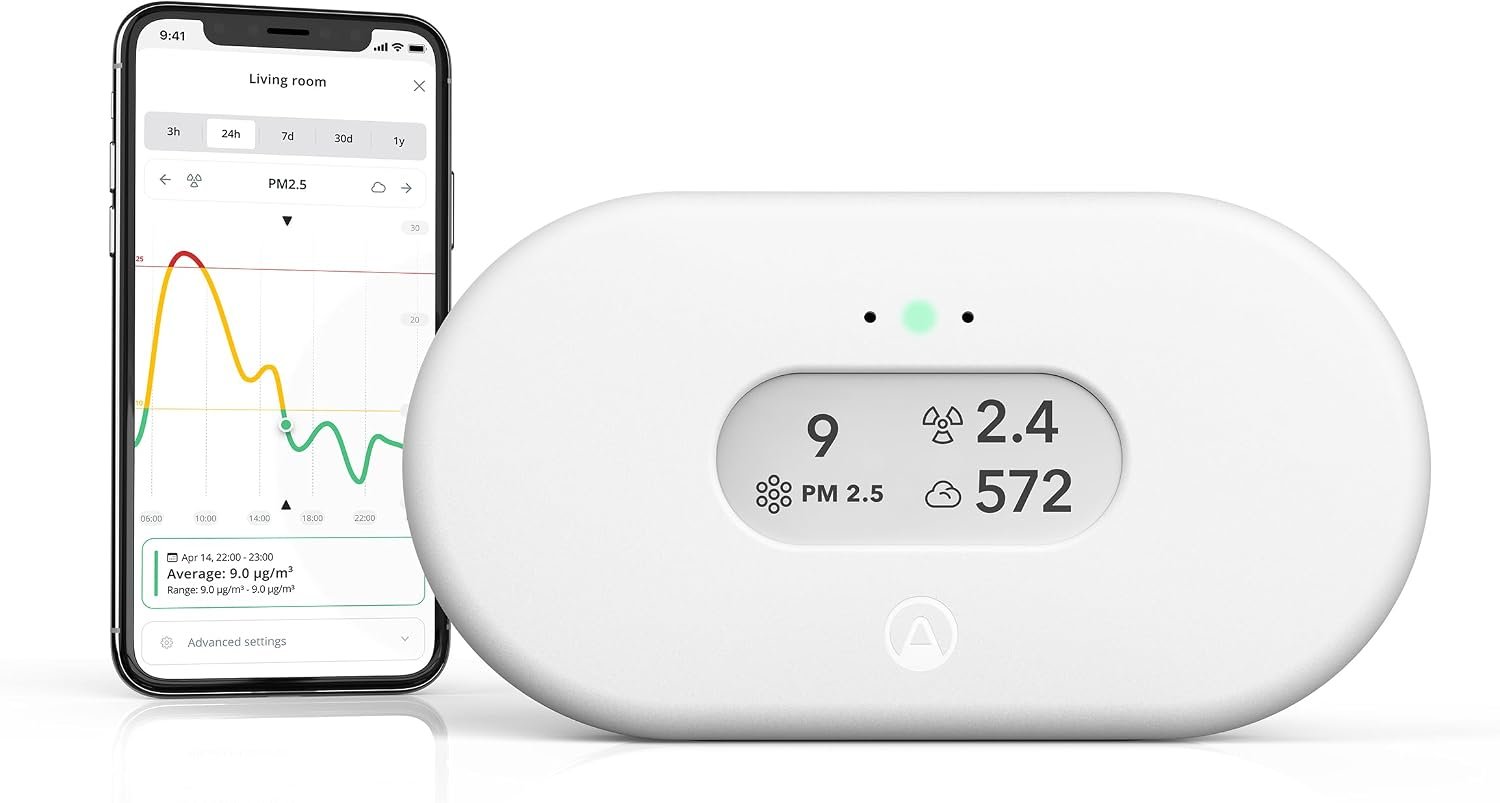
Airthings View Plus Air Quality Monitor
As an Amazon Associate I earn from qualifying purchases.
The Airthings View Plus Air Quality Monitor is designed for people who want a clearer picture of what is happening in the air inside their home without filling the room with another conspicuous piece of technology.
Its white rectangular body is deliberately understated, while the e-paper screen can display up to four selected readings at a time. Behind that simple appearance are sensors for radon, particulate matter, carbon dioxide, volatile organic compounds, humidity, temperature and air pressure.
That combination makes it particularly interesting going into fall and winter, when windows tend to stay closed for longer and indoor air can change without anything obvious being visible.
Why it works in a smart home
The View Plus does more than display a number on a screen.
It connects to Wi-Fi and sends readings to the Airthings app and web dashboard, where changes can be viewed over time rather than judged from a single snapshot. That is useful because indoor air quality often makes more sense as a pattern: CO₂ rising when a room is occupied, humidity changing after cooking or showering, or particulate levels increasing at certain times of day.
The monitor also has a colour status indicator using green, yellow and red, so you do not necessarily need to open the app every time you walk past it.
For a connected home, Airthings supports integrations including Amazon Alexa, Google Assistant and IFTTT. That gives the View Plus more potential than a standalone meter, particularly if you already use smart-home routines.
What it feels like to use
Physically, the View Plus is quite restrained.
The matte white casing and e-paper screen give it more of a calm instrument-panel feel than a bright electronic display. Because e-paper does not glow continuously like an LCD tablet screen, it can sit on a shelf or wall without constantly drawing attention.
You can choose up to four measurements to show directly on the display, while the full set of data remains available through the app.
It can sit upright on a flat surface or be wall-mounted, and Airthings recommends positioning it roughly around breathing height rather than hiding it near the floor or ceiling.
Power is flexible too. Six AA batteries are supplied, and Airthings quotes up to two years of battery life depending on Wi-Fi conditions and sensor settings. USB-C power is another option.
That cable-free option is useful in a living room or bedroom because the monitor does not have to sit beside a power socket.
The drawbacks
The biggest limitation is easy to misunderstand: the View Plus does not improve the air.
It measures and reports what is happening. If CO₂ rises, humidity becomes excessive or particulate levels increase, you still need to decide what to do about it by ventilating the room, using extraction, changing habits or running suitable air-cleaning equipment.
That distinction matters because this is a monitoring tool, not an air purifier.
There is also a settling-in period with some measurements. Radon in particular is something that becomes more meaningful over time rather than from a quick reading after taking the monitor out of the box. Airthings gives radon accuracy figures after seven days and again after two months, which reinforces the fact that this is intended for ongoing monitoring.
The number of sensors can be another mixed blessing. For somebody who enjoys data, having seven measurements is useful. For somebody who simply wants to know whether a room feels stuffy, the app and graphs may be more information than necessary.
Wi-Fi support is limited to 2.4GHz networks, so households running unusual network configurations may need to pay attention during setup.
Battery life also depends on how the device is configured. Airthings quotes up to two years, but more frequent particulate sampling and network behaviour can shorten that. On battery power, PM measurements are sampled every 10 minutes by default; when powered through USB-C, that can increase to every 2.5 minutes.
The e-paper screen is another deliberate compromise. It is pleasantly unobtrusive and power-efficient, but anyone expecting a bright colour touchscreen may initially find it plain.
Then there is the question of whether you will actually act on the information.
An air-quality monitor is most useful when its readings change behaviour. If elevated CO₂ simply becomes another graph that is glanced at and ignored, much of the value disappears.
Radon monitoring also requires patience. Unlike a smoke alarm, where the desired state is fairly binary, radon data is about longer-term exposure and trends. A few hours of readings should not be treated as a complete assessment of a home.
Finally, this is a connected product. Although the display works as an immediate readout, much of the deeper value comes from using the Airthings app or dashboard. Anyone deliberately avoiding apps, cloud-connected devices or smart-home ecosystems may prefer a simpler standalone meter.
Who it suits best
The Airthings View Plus makes most sense for people who want to understand their indoor environment rather than guess at it.
It should be particularly useful in bedrooms, home offices and living areas where several people may spend long periods with the windows closed.
It also suits households interested in radon monitoring because that measurement is built into the same device as the more everyday CO₂, humidity and particulate sensors.
For smart-home users, the Wi-Fi connectivity and integrations make it easier to include air-quality information alongside heating, ventilation and other home data.
And visually, its restrained design should help it blend into a room rather than looking like laboratory equipment.
Is it worth the smart-home space?
The Airthings View Plus earns its place by combining several separate indoor-air measurements into one quiet, compact device.
Its value is not in producing dramatic changes by itself. Instead, it gives you information that can help explain why a room feels stale, when ventilation may be needed, or how indoor conditions change over days and weeks.
For someone who only wants a basic temperature and humidity reading, it is probably more equipment than necessary.
But for a connected home where radon, CO₂, particles and broader air-quality trends genuinely matter, the View Plus provides a much fuller picture without turning the room into a collection of separate sensors.
Explore more connected home technology in our Smart Home & Security section.
As an Amazon Associate I earn from qualifying purchases.