
SwitchBot Blind Tilt
As an Amazon Associate I earn from qualifying purchases.
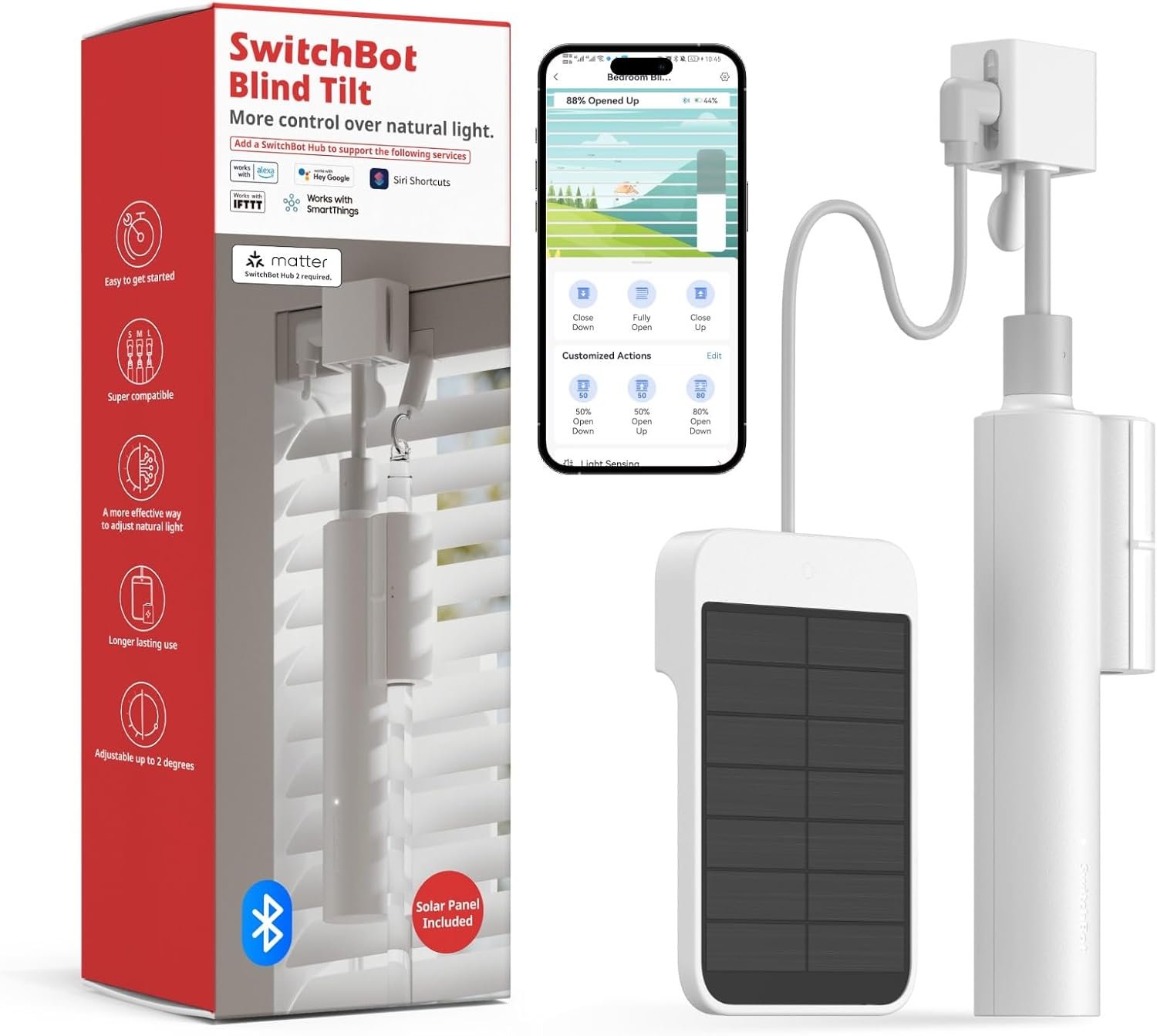
The SwitchBot Blind Tilt brings smart automation to ordinary horizontal window blinds without requiring a complete replacement.
Designed to attach to the existing tilt wand, this compact motorised controller adjusts the angle of the blind slats through a smartphone app, automatic schedules or compatible smart-home systems.
Its solar-assisted charging system adds convenience, while the ability to manage natural light throughout the day makes it particularly interesting for bedrooms, living rooms and home offices.
Rather than introducing another complicated household gadget, the SwitchBot aims to make something familiar work a little more intelligently.
Why it works in a smart home
The main attraction of the SwitchBot Blind Tilt is its retrofit design.
Traditional motorised blinds often involve replacing existing window coverings or installing dedicated electrical equipment.
The SwitchBot takes a simpler approach by fitting around the operating wand of compatible horizontal blinds.
Once installed and calibrated, its motor rotates the wand to adjust the angle of the slats.
This allows users to control incoming daylight without walking across the room to make repeated manual adjustments.
The motor provides precise adjustments in increments as small as two degrees, allowing greater control over light and privacy than simply choosing between fully open and fully closed positions.
A built-in light sensor can also respond to changes in ambient brightness through the appropriate app settings.
This is useful in rooms where afternoon sunlight creates glare on television screens or computer monitors.
For anyone considering broader window automation, our SwitchBot Curtain 3 Smart Curtain Opener explores a related technology designed to move curtains rather than adjust blind slats.
Both products bring automation to existing window coverings, but they solve different problems.
What it feels like to use
The SwitchBot Blind Tilt has a compact white housing with a practical, unobtrusive appearance.
It attaches vertically to the blind’s operating wand, allowing the existing slats and headrail to remain in place.
Although the controller is visible, its light-coloured finish should blend reasonably well with many conventional window blinds.
The everyday experience revolves around the SwitchBot smartphone app.
Users can adjust the slat angle, create operating schedules and configure supported light-responsive settings.
For example, blinds could be programmed to admit morning daylight and tilt towards a more private position in the evening.
The motor is designed to operate quietly, with SwitchBot specifying operating noise as low as approximately 40 dB.
That does not make it completely silent, but the brief mechanical movement should be less intrusive than many larger household appliances.
The built-in 2000 mAh rechargeable battery is another useful feature.
SwitchBot quotes approximately ten months of battery operation under specific testing conditions.
An included solar panel can help maintain the charge when positioned where it receives sufficient daylight.
This reduces the need to connect a charging cable regularly, although actual charging performance depends on the installation.
The device also supports manual wand adjustment, allowing users to change the blinds physically when convenient.
Scheduling and smart-home integration
Basic control works through Bluetooth using the SwitchBot app.
Users can configure schedules and manage compatible devices while within Bluetooth range.
Adding a compatible SwitchBot Hub expands the possibilities considerably.
Depending on the hub, users can enable remote operation, voice commands and integration with supported smart-home platforms.
This could allow blind adjustments to become part of a wider morning or evening routine.
For example, a household might combine automated blinds with temperature scheduling using a connected device such as the ecobee Smart Thermostat Premium.
These are separate products with different functions, but they illustrate how lighting and room comfort can become part of a coordinated smart-home routine when supported by the chosen platform.
The appeal is convenience rather than novelty.
Once configured properly, the blinds can make small adjustments without requiring constant attention.
The drawbacks
The SwitchBot Blind Tilt offers useful automation, but compatibility is its biggest limitation.
It is not designed for every type of window blind.
The controller works with compatible horizontal blinds operated by a rotating wand.
It does not work with roller blinds, vertical blinds or systems using an incompatible operating mechanism.
Even among horizontal blinds, wand dimensions matter.
SwitchBot specifies supported operating rods with particular diameters, so these measurements should be checked before ordering.
An unusual wand shape or a damaged mechanism may prevent the controller from fitting or operating correctly.
Another important limitation is that it only adjusts the angle of the slats.
The device cannot raise or lower the entire blind.
Anyone expecting fully automated opening and closing may be disappointed.
This distinction is especially important when comparing the SwitchBot with complete motorised blind systems.
The solar panel is helpful, but its effectiveness depends on daylight exposure.
A north-facing window, deeply recessed installation or position shaded by surrounding buildings may provide insufficient light to maintain the battery indefinitely.
The quoted battery life is based on controlled testing conditions, not a guarantee for every installation.
Charging frequency will depend on operating schedules, motor workload, battery condition and the amount of available sunlight.
Although the motor is relatively quiet, it still produces an audible mechanical sound.
In a very quiet bedroom, particularly early in the morning, that brief sound may be noticeable.
Installation is another consideration.
The device must be attached correctly to the wand and calibrated through the app. While this avoids replacing the blinds, it is not quite as effortless as placing a standalone smart device on a shelf.
Older blinds with stiff or poorly maintained mechanisms may also place additional strain on the motor.
The original wand should rotate smoothly before automation is added.
The requirement for an additional hub is worth understanding.
Basic Bluetooth control and local scheduling are available without a hub, but remote access and many third-party voice-control features require compatible SwitchBot hardware sold separately.
Apple Home integration through Matter also depends on a suitable SwitchBot hub acting as a bridge.
Someone expecting complete smart-home integration directly from the controller could therefore face an unexpected additional purchase.
Another issue is the appearance of the installation.
The white motor housing is relatively compact, but it remains visible on the blind wand.
For interiors where completely concealed technology is important, the additional hardware may be less attractive than an integrated motorised blind system.
Homes with several windows may need a separate controller for each blind, increasing the number of devices requiring installation, calibration and occasional maintenance.
Finally, the SwitchBot introduces app connectivity, firmware and rechargeable electronics into something previously operated by a simple mechanical wand.
For households that enjoy practical automation, this may be worthwhile.
For someone who adjusts their blinds only occasionally, the added complexity may offer little everyday benefit.
Who it suits best
The SwitchBot Blind Tilt makes most sense for households already using compatible horizontal blinds.
It is particularly appealing for home offices where changing daylight can create unwanted screen glare.
Bedrooms and living rooms are also sensible locations, especially where blinds are adjusted at regular times each day.
People already using SwitchBot products may appreciate the ability to include blind adjustments within their existing routines.
The retrofit approach is also attractive for anyone who wants smarter window coverings without replacing perfectly serviceable blinds.
More generally, it follows the same practical philosophy as our Meross MSG200 Smart Garage Door Controller: adding connected features to suitable existing equipment rather than replacing the entire system.
However, those wanting complete blind raising and lowering should consider a different type of motorised window covering.
Is it worth adding to your smart home?
The SwitchBot Blind Tilt offers a thoughtful approach to home automation.
Its strength lies in improving an ordinary household feature rather than replacing it with something unnecessarily complicated.
Precise slat adjustment, scheduling and solar-assisted charging are useful additions, particularly in rooms where natural light changes considerably throughout the day.
The main compromises are compatibility restrictions, the inability to raise or lower blinds, and the additional hub required for more advanced connected features.
You can explore more practical connected devices in our Smart Home & Security guides, covering useful technologies designed to make everyday living easier.
For homes with suitable horizontal blinds, the SwitchBot Blind Tilt is an appealing way to introduce automated light control without the expense and disruption of replacing existing window coverings.
As an Amazon Associate I earn from qualifying purchases.