
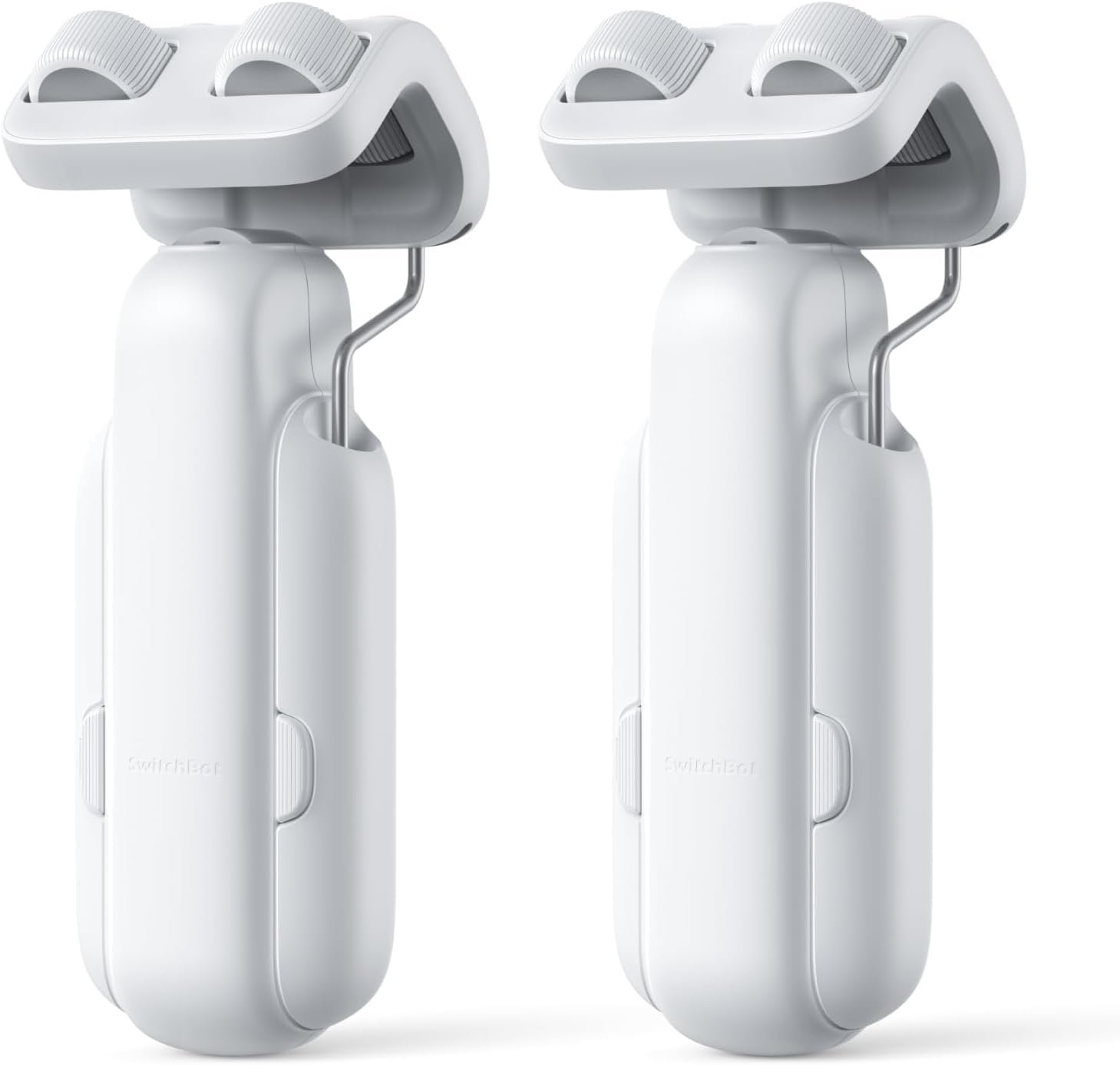
SwitchBot Curtain 3 Smart Curtain Opener
As an Amazon Associate I earn from qualifying purchases.
The SwitchBot Curtain 3 Smart Curtain Opener is designed to automate existing curtains without replacing the curtain rod, fitting a motor into a part of the room that normally has no technology at all.
This particular package contains two Curtain 3 units for centre-opening curtains. Each unit sits behind the fabric and moves one side along the rod, allowing both curtains to open or close together through the SwitchBot app.
For a bedroom or living room where the curtains are opened every morning and closed every evening, it turns a repetitive manual job into something that can happen automatically on a schedule.
Why it works in a smart home
One of the strongest things about Curtain 3 is that it does not require a complete motorised-curtain installation.
The existing rod and curtains stay in place. The Curtain 3 units attach to the rod behind the fabric, positioning magnets are fitted, and the system is calibrated through the app.
SwitchBot rates each Curtain 3 for curtains weighing up to 15 kg, so the motors are designed to move considerably more than lightweight voile panels.
Once installed, the curtains can be opened fully, closed, or moved to a chosen percentage through the app.
Scheduling is particularly useful.
You might have bedroom curtains open automatically in the morning and close after sunset, or have living-room curtains close at a regular evening time without needing to walk around the house doing each window manually.
Without a SwitchBot Hub, the Curtain 3 can store up to five schedules locally. Adding a compatible Hub removes that limit and expands the smart-home options.
What it feels like to use
The Curtain 3 itself is mostly hidden once fitted.
You see the curtain rather than a prominent motor or track system, which is important in a room where the technology should ideally disappear into the background.
In normal operation there is an audible electric-motor sound as the curtains move. SwitchBot quotes around 42–45dB in normal mode depending on its published material, which is roughly the sort of gentle mechanical hum you notice but would not usually describe as loud.
For quieter movement, there is QuietDrift mode.
This slows the curtains down considerably and reduces operating noise to below 25dB at one metre. That makes far more sense for something like a bedroom schedule where you want curtains to begin moving in the morning without the mechanism itself becoming an alarm clock.
There is a trade-off, though: SwitchBot says QuietDrift uses more battery, something worth remembering if you plan to use it for every scheduled movement.
Battery power keeps the installation tidy
Each Curtain 3 contains a 3350mAh rechargeable lithium-ion battery and charges over USB-C.
SwitchBot quotes up to eight months of battery life, based on opening and closing an 8 kg curtain on a three-metre track once per day under its test conditions. Real battery life will naturally depend on curtain weight, movement frequency, temperature and how often quieter operating modes are used.
That long battery interval is important because the whole appeal would disappear fairly quickly if charging became a weekly chore.
An optional SwitchBot Solar Panel can also keep the Curtain 3 topped up, although the solar panel is sold separately and obviously needs enough useful light to make sense.
For most rooms, rechargeable battery power keeps the installation much cleaner than running cables around a curtain pole.
Voice control and broader automation
On its own, Curtain 3 communicates primarily through Bluetooth.
To bring it properly into a wider smart-home setup, you need a compatible SwitchBot Hub.
With a Hub, SwitchBot supports voice control through services including Alexa, Google Assistant, Siri Shortcuts, SmartThings and IFTTT.
Matter support is available through compatible SwitchBot bridge devices such as Hub 2, Hub 3 and Matter-enabled Hub Mini. Curtain 3 can then be exposed to platforms such as Apple Home and controlled by percentage as well as fully open or closed.
This is where the product becomes more interesting than simply replacing the act of pulling curtains by hand.
Curtains can become part of wider routines.
A morning scene could open the curtains alongside lights and heating changes. An evening scene could close them while switching selected lights on. Used with other suitable smart-home equipment, curtain movement becomes another part of the room responding automatically rather than an isolated gadget.
Why the 2-pack matters
Centre-opening curtains require two Curtain 3 units, one for each side. SwitchBot states this explicitly, which makes the 2-pack shown here the appropriate configuration for the common arrangement where two curtains meet in the middle.
Both sides can work together, but SwitchBot also allows individual control of one side when the system is configured for dual curtains.
That can be useful if you occasionally want only one curtain partly open without moving the entire pair.
This particular version is designed for curtain rods, so that detail needs checking before buying. SwitchBot sells separate designs for other track types.
The drawbacks
Compatibility is the first thing I would check carefully.
This listing is specifically the Rod version. If your curtains run on a U-rail or I-rail track, you need the appropriate Curtain 3 version rather than assuming one model fits every installation.
Even with curtain rods, dimensions matter.
SwitchBot warns that some extendable rods can create compatibility problems, particularly where the thinner telescoping section falls below the supported diameter. A decorative rod with unusual joints, rings or brackets deserves checking before ordering.
Centre-opening curtains also require two units.
That is already covered by this 2-pack, but it matters when comparing configurations. A single Curtain 3 cannot independently pull both halves of a conventional centre-opening pair.
The motor strength has limits too.
Each unit is rated for up to 15 kg / 33 lb under SwitchBot’s controlled testing. Very heavy lined curtains, stiff curtain rings or rods with poor sliding action can make the motor work harder even when the fabric itself appears to fall within the weight limit.
The curtains therefore need to move reasonably freely by hand before automation is added. A motor is not a good substitute for fixing a rod that catches, bends or has badly sticking rings.
Normal operation is not silent.
The quieter QuietDrift mode drops below 25dB, but it also moves the curtains more slowly and consumes battery more quickly. SwitchBot specifically recommends considering solar charging when QuietDrift is used heavily.
QuietDrift also has limitations in how it can be triggered. SwitchBot’s support documentation notes that it is not available through voice assistants in the same way as normal operation.
The quoted eight-month battery life should also be treated as a best-case test figure rather than a promise for every room.
Heavier curtains, frequent operation, cold temperatures and regular QuietDrift use can shorten the interval between charges.
Charging is simple through USB-C, but the motors sit near the top of the curtains. Depending on your window height, taking the devices down or running a charging cable to them may be less convenient than charging something sitting on a table.
A solar panel can reduce that inconvenience, although that means buying another piece of hardware and finding a position where it receives enough light.
Another important limitation is the Hub requirement.
You do not need a Hub for basic Bluetooth app operation and local scheduling, but many of the features people associate with a smart home — remote access, voice assistants, Matter and broader automations — depend on adding a compatible SwitchBot Hub.
That means the basic 2-pack is not necessarily the complete setup if your goal is Apple Home, Alexa or whole-home automation.
The physical appearance will not suit everyone either.
SwitchBot does a good job of positioning the mechanism behind the curtain, but it is still a fairly chunky motorised device attached to the rod. With some curtain styles it virtually disappears; with very light or sheer curtains it may be more noticeable.
Installation is designed to avoid tools, but it is not completely effortless.
The units need fitting, magnets positioning and calibration through the app. Curtains with awkward rings, unusual headers or decorative rods can take more patience than a perfectly conventional setup.
There is also a behavioural question worth considering.
If you open and close one lightweight pair of curtains once per day and walking over to them has never bothered you, Curtain 3 solves a fairly small problem.
Its value becomes clearer in bedrooms, hard-to-reach windows, several automated rooms, heavier curtains or households where scheduled opening and closing genuinely makes everyday life easier.
Finally, this remains a battery-powered connected device.
A traditional curtain rod can work for decades with virtually no attention. Curtain 3 introduces rechargeable batteries, firmware, an app and wireless connectivity into something previously mechanical.
For smart-home enthusiasts that is the attraction. For somebody deliberately trying to reduce the number of connected devices in the house, manual curtains remain beautifully uncomplicated.
Who it suits best
The SwitchBot Curtain 3 makes most sense for somebody who already enjoys using schedules and routines around the home.
Bedrooms are an obvious fit. Curtains can open gradually and quietly in the morning rather than remaining closed until someone remembers them.
Living rooms also make sense when curtains are routinely closed at dusk, particularly around large windows where manually moving heavy fabric every evening becomes tiresome.
It should also appeal to people who want motorised curtains but do not want the disruption and permanence of replacing the existing rod with a wired motorised track.
For households already using SwitchBot products, adding Curtain 3 to existing scenes and Hub-based automation is particularly natural.
Is it worth the smart-home space?
The SwitchBot Curtain 3 works because it automates something very ordinary without requiring the room to be rebuilt around it.
The motors attach to the existing curtain rod, the curtains themselves stay in place, and the 2-pack handles the common centre-opening arrangement.
Scheduling, app control and QuietDrift make it useful even as a standalone system, while adding a compatible Hub opens the door to voice control, Matter and broader home automations.
It does require careful compatibility checking, and the smartest features need additional SwitchBot hardware. Battery charging and motor noise are also real considerations rather than details to ignore.
But where opening and closing curtains is already a repetitive daily routine, Curtain 3 turns a completely ordinary part of the room into one that can quietly take care of itself.
Explore more connected home technology in our Smart Home & Security section.
As an Amazon Associate I earn from qualifying purchases.