
Life360 Tile Essentials 4-Pack
As an Amazon Associate I earn from qualifying purchases.
Losing your keys somewhere in the house is annoying. Misplacing a wallet, leaving a bag behind or discovering that the television remote has somehow disappeared into the sofa can be even more frustrating.
The Life360 Tile Essentials 4-Pack is designed around those ordinary situations rather than trying to turn every possession into a complicated piece of technology.
Instead of giving you four identical trackers, the pack combines different Tile shapes for different belongings: two Mate trackers, one card-shaped Slim and one adhesive Sticker. That makes the set useful for several everyday items rather than forcing the same tracker onto everything.
Why the mixed 4-pack makes sense
The strongest part of the Tile Essentials pack is the variety.
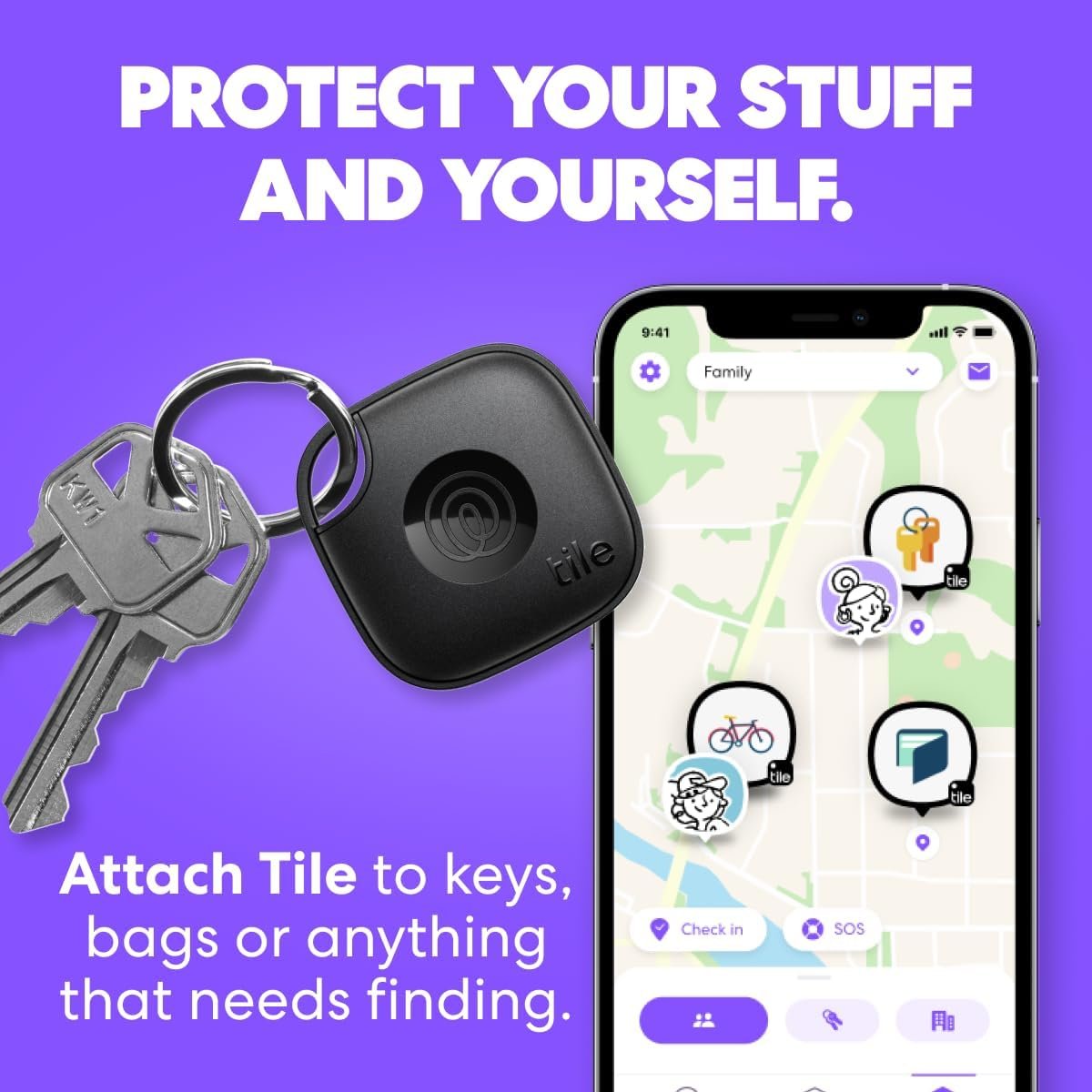
The two Tile Mate trackers are the general-purpose models. Their built-in holes make them suitable for keys, bags, backpacks and similar items where a conventional tag shape works well.
The Tile Slim has a very different job. At roughly credit-card proportions and only 2.5 mm thick, it is designed to slide into a wallet, passport holder or luggage compartment without the bulk of a conventional tracker hanging from it.
The Tile Sticker is smaller again and has an adhesive back. It is intended for belongings where there is nowhere sensible to attach a keyring-style tracker, such as a television remote or certain pieces of equipment.
That mix is more practical than four identical devices if you are trying to cover the things people genuinely tend to misplace.
You might put one Mate on your keys, another on a frequently carried bag, slide the Slim into your wallet and attach the Sticker to the remote that always seems to vanish.
How Tile actually finds your belongings
It is important to understand that Tile is a Bluetooth tracker, not a miniature GPS tracker.
When a Tile is within Bluetooth range of your phone, the Life360 or Tile system can connect to it and make the tracker ring. If the item is somewhere nearby — under a cushion, inside another bag or in a coat pocket — following the sound can make finding it considerably easier.
The app can also show the last location where the Tile successfully connected.
That gives you somewhere sensible to begin looking if you realise an item is missing after you have already left the area.
If the Tile is no longer within your own Bluetooth range, the Tile Network can help. Compatible devices passing within range can anonymously update the missing Tile’s location, allowing you to receive a notification through the Notify When Found feature.
It is a clever system, but it is not the same as watching a GPS dot move continuously across a map.
That distinction matters.
What the different trackers feel like to use
The Mate is the one most people will probably handle regularly.
Life360 lists the current 2024 Mate at about 37.6 mm square and 7.4 mm thick, weighing around 8 g. It has a quoted Bluetooth range of up to 350 ft and a 100 dB ring.
It feels more like a small key fob than a piece of serious electronics, which is exactly what you want from something hanging beside your keys every day.
The Slim is much flatter.
At about 85.4 x 53.9 x 2.5 mm, it follows the proportions of a card closely enough to disappear into a wallet or travel document holder. Its quoted range is also up to 350 ft, while Life360 rates its ring at 104 dB.
The Sticker measures only around 28 mm across and weighs about 6 g. Its quoted range is shorter at up to 250 ft, but that is understandable given its much smaller body.
The adhesive design changes where it can be used. Instead of hanging from an object, it becomes part of it.
The Life360 connection
The modern Tile system is now closely tied to Life360.
Tiles can appear within the Life360 app alongside other connected people and items, making it possible to manage belongings without treating the tracker as an entirely separate system. Life360 supports both iOS and Android.
Core finding features do not require a paid Tile subscription.
Life360 says users can ring a nearby Tile, see its last known location, use Notify When Found through the Tile Network, use the Tile Detector and share a Tile with another person without Premium or Premium Protect.
That is worth knowing because the trackers remain useful without automatically committing to another monthly service.
Life360 does offer additional membership features, but the basic job of helping you find ordinary belongings remains available without one.
Find your phone as well as your keys
The system also works in the opposite direction.
If you have your Tile but cannot find your phone, the Tile’s button can be used to make the phone ring while it is within Bluetooth range — even when the phone is set to silent.
That sounds like a small feature until the day the phone has slipped between the sofa cushions and calling it from another phone is not convenient.
There is an important detail, however.
On current 2024 Tiles connected through Life360, the button can be configured for either the Find My Phone action or the newer SOS function. If it is configured to send an SOS alert, the same button action is no longer being used to ring the phone.
So there is a choice to make about what that button does.
An SOS button built into the tracker
The 2024 Tile range adds another feature that older Tile articles may not mention at all.
Compatible current models can be set up through Life360 to send a discreet SOS alert.
When configured for SOS, pressing the Tile button three times can trigger an alert through the connected phone. Members of the user’s Life360 Circle and nominated emergency contacts can then receive a notification along with the user’s location.
It is worth being precise here: the Tile itself is not independently calling emergency services or transmitting its own GPS position.
The feature works through the linked Life360 system and connected phone.
The exact alert handling can also vary depending on the Life360 membership level and country, so I would view SOS as an additional connected feature rather than the main reason to buy the trackers.
Their primary job remains helping you find belongings.
Battery life and water resistance
All three tracker types included in this current Essentials pack use sealed batteries rated for up to three years.
That includes the Mate, Slim and Sticker. Unlike the current Tile Pro, their batteries are not user-replaceable.
There is an advantage to the sealed construction: once activated, there is no regular charging routine and no coin cell to replace every few months.
You attach the tracker and largely forget about the battery.
The downside is equally clear. When the battery eventually reaches the end of its life, you cannot simply open the case and fit another one.
Life360 also rates the current Mate, Slim and Sticker as IP68 water resistant.
That is reassuring for keys or bags that occasionally encounter rain or everyday spills, although I would still avoid treating them as pieces of equipment intended for repeated underwater use.
The drawbacks
The biggest limitation of the Tile Essentials pack is the one most easily misunderstood: these are not GPS trackers.
A Tile does not independently know where it is and continuously transmit that position over a mobile network.
It relies on Bluetooth connections with phones and the Tile Network. The location shown in the app is based on where the tracker was last detected rather than a guaranteed live position.
That distinction becomes particularly important if you are thinking about tracking a moving vehicle, pet or person.
Tile is primarily an item finder.
If your keys are somewhere inside the house, it can be extremely useful. If your luggage has been left somewhere and another compatible device passes nearby, the network may update its location.
But it should not be expected to behave like a cellular GPS tracker providing continuous real-time movement.
The advertised Bluetooth range is also a maximum figure.
Life360 quotes up to 350 ft for Mate and Slim and up to 250 ft for Sticker, but walls, floors, furniture, trees and other wireless interference can reduce the real-world connection distance. Life360 itself notes that environmental obstacles can interrupt Bluetooth connections.
Inside a house, you should therefore think of the quoted figures as best-case ranges rather than guarantees.
The Tile Network introduces another variable.
When your missing Tile is outside your own range, an updated location depends on a compatible device passing close enough to detect it. In a busy town or public building that may happen relatively quickly; in an isolated area with few users it may take much longer or not happen until someone comes near.
Life360 specifically notes that Notify When Found updates may not be immediate.
The batteries create another compromise.
Three years is a useful lifespan for a device you do not need to recharge, but Mate, Slim and Sticker batteries in the current generation are non-replaceable.
When the battery eventually expires, the tracker itself reaches the end of its practical service life.
Some people will prefer that sealed simplicity. Others may dislike replacing an entire electronic device because one battery has run down.
The Sticker has its own practical limitation.
Its adhesive back is ideal for things like remotes, but attaching something with adhesive is inherently less flexible than looping a Mate through a keyring.
Once you have chosen a location, moving the Sticker repeatedly between different belongings is not what the design is intended for.
The Slim is beautifully thin, but that thinness also means there is no replaceable battery and no convenient attachment hole. It makes most sense when it can remain inside a wallet, passport holder or bag pocket rather than being moved around constantly.
The SOS feature deserves some thought as well.
On a compatible 2024 Tile, the button can be assigned to discreet SOS or to finding the phone. You cannot assume both button behaviours will be active at the same time.
SOS also depends on the Life360 connection and phone rather than turning the tracker into an independent emergency communicator.
The app is another part of the equation.
Tile is useful because hardware and software work together. If Bluetooth is disabled, location permissions are restricted, the app is prevented from operating correctly in the background or the phone itself is unavailable, some finding functions will naturally be affected.
Some people also simply do not want another app and connected account involved in finding everyday possessions.
For those users, a traditional labelled keyring remains much simpler.
And finally, even the best tracker cannot guarantee that a lost or stolen item will come back.
Tile can give you information that helps locate something. It cannot physically retrieve an item, and a network location may have changed by the time you arrive. Life360 advises contacting local authorities rather than confronting someone if you believe a Tile-tagged item has been stolen.
Who it suits best
The Life360 Tile Essentials 4-Pack makes the most sense for someone who regularly carries several easy-to-misplace belongings rather than needing a tracker for one specific item.
The two Mate trackers work naturally with keys and bags.
The Slim makes sense for a wallet or travel documents.
The Sticker is useful for the sort of household item that has no convenient keyring attachment but still manages to disappear regularly.
It is also a sensible option for households that use both iPhone and Android devices, since Life360 supports the Tile system on both platforms.
Travellers may appreciate having different tracker formats for a wallet, carry-on bag and luggage, while families can divide the pack between several commonly misplaced items.
Is it worth the smart-home space?
The clever part of the Life360 Tile Essentials 4-Pack is not that each tracker does something dramatically different.
It is that the shapes are designed around different belongings.
Mate suits the things you can hang a tracker from. Slim disappears into the things that need something flat. Sticker deals with objects that provide nowhere sensible to attach either of them.
The current generation also adds longer-term sealed batteries, IP68 water resistance and Life360’s SOS capability while retaining the basic Tile features of ringing nearby belongings, viewing their last known location and using the wider Tile Network when something is farther away.
The system has clear limitations. It is Bluetooth rather than GPS, the network cannot promise an immediate location update, and the batteries in these particular trackers cannot be replaced.
But for ordinary keys, wallets, bags and those household objects that always seem to vanish at precisely the wrong moment, the Tile Essentials pack provides a practical layer of technology without turning the belongings themselves into complicated smart devices.
Explore more connected devices in our Smart Home & Security section.
As an Amazon Associate I earn from qualifying purchases.