
A Quieter Weekend Morning in the Garden
As an Amazon Associate I earn from qualifying purchases.
When the Smallest Chore Becomes the Loudest Friction
There’s a specific kind of quiet that settles over a neighborhood on a Saturday morning. The coffee is still warm, the sun isn’t too high yet, and the only sounds are the distant coo of a mourning dove and the gentle rustle of leaves. It’s a pocket of peace that feels almost sacred. And then, somewhere down the block, a gas engine roars to life, shattering the stillness into a thousand pieces. Suddenly, the calm is replaced by a mechanical growl that vibrates through the windows and makes you wince into your mug. Weekend yard work has officially begun, and it’s impossible to ignore.
For so long, that loud, shaky start was just the accepted soundtrack of caring for our little patches of green. We’d brace for the pull-cord tug-of-war, mix fuel, and accept the lingering smell of gasoline on our hands and in the air as a necessary part of the ritual. But lately, something has been shifting. A walk through the garden center or a scroll through a neighbor’s open garage tells a different story. The bulky, fume-belching machines are slowly being replaced by sleeker, quieter ones. It’s not just a tech upgrade; it feels like a lifestyle shift. The goal isn’t just a tidy lawn anymore—it’s a tidier, calmer experience in getting there.
This quiet revolution is happening largely on battery platforms, and it’s gently changing how we feel about our most routine chores. The idea of stepping outside, pressing a button, and getting to work without a pre-ritual of yanking cords and donning ear protection is deeply appealing. It reframes yard work from a disruptive event into a seamless, almost peaceful part of a morning. The tool becomes an extension of the quiet, not a disruption of it. And that’s where the real magic of modern cordless yard maintenance lives.
Rethinking the Power Behind the Peace
For a long time, the trade-off for quiet battery power was a sacrifice in muscle. The worry was that an electric grass trimmer would stall at the first sign of a thick clump of crabgrass or bog down in the damp morning dew, turning a quick tidy-up into a frustrating, stop-and-start battle. That hesitation kept many of us locked into gas, tolerating the noise and fumes for the sake of reliability. But the engineering inside these new tools tells a different story now.
Think of a brushless motor as the heart of the machine. Without getting tangled in the technical weeds, it’s essentially a smarter, more efficient way of delivering power. It cuts out the internal friction that plagues older-style motors, which means the energy from the battery goes directly into the spinning of the line. This translates to a few tangible things you’ll feel more than you’ll see. There’s no lag when you press the trigger, just an immediate, steady whirl. It responds smoothly when you move from light, feathery grass along a fence line to a dense patch of weeds that have gotten a little too comfortable. It doesn’t complain or whine; it just adjusts and keeps going with a consistent, reassuring hum. That hum is key—it’s a sound you can work with while still hearing the birds, and you can do it without feeling like you need to apologize to the neighbor whose baby is napping.
How a Wider Reach Changes Your Rhythm
There’s a subtle choreography to trimming a yard. It’s in the way you arc the tool around a flower bed, edge along a sidewalk, and duck under low-hanging shrubs. A big part of what makes that dance feel either clumsy or graceful comes down to the cutting width of the tool. A narrow, 11- or 12-inch path can make the job feel like coloring in a large drawing with a sharp pencil—precise, yes, but tediously slow. A 15-inch cutting swath, on the other hand, is like switching to a nice, smooth marker.
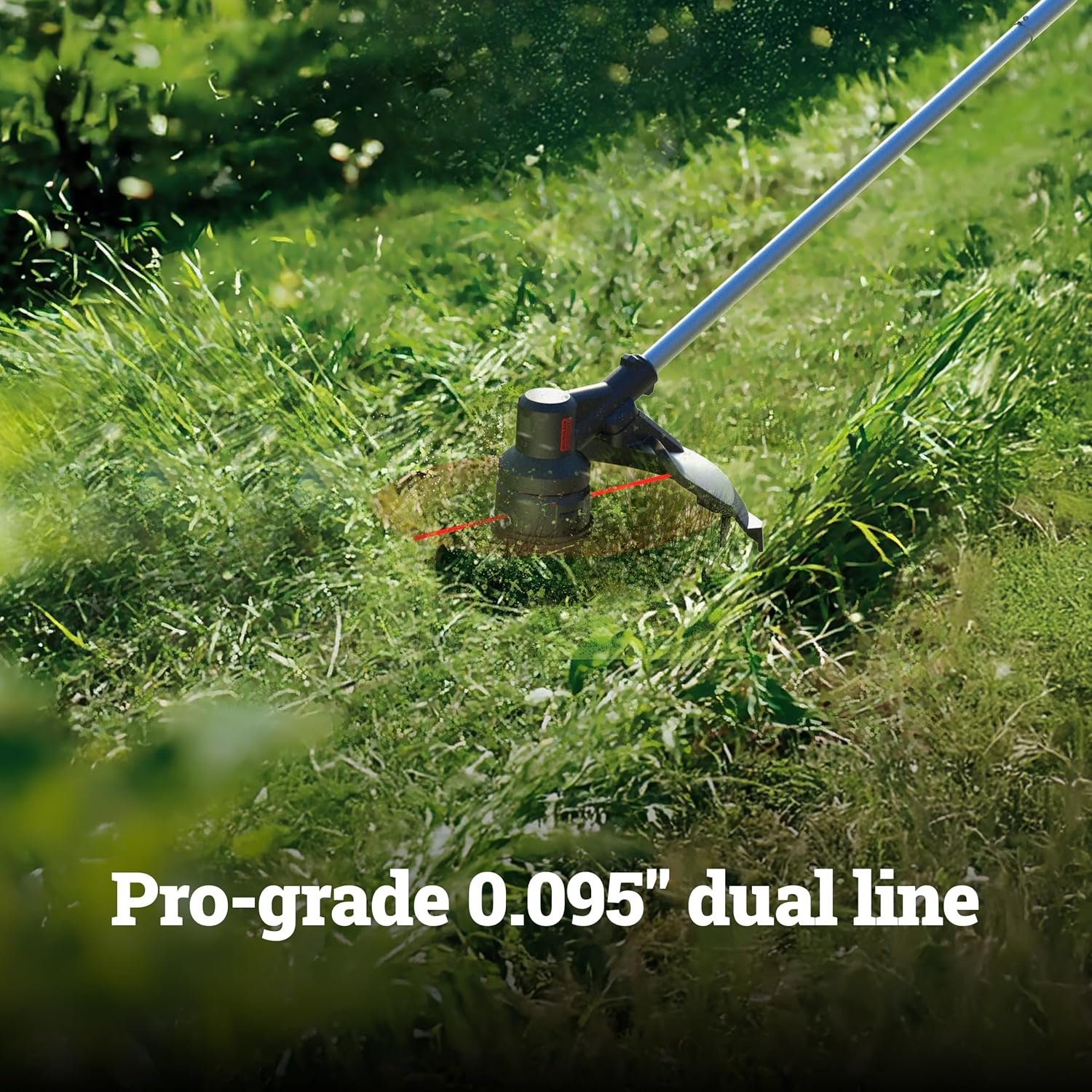
That extra few inches of reach changes your physical rhythm. You’re not taking as many steps. You’re not endlessly swinging back and forth to cover a small patch of ground. You can see your progress in real, satisfying strokes. It makes the job faster, certainly, but it also makes it feel less like a repetitive task and more like a single, fluid motion from the back door to the fence gate. The dual-exit head on some trimmers feeds line from two sides, which helps create a cleaner cut and doesn’t mat down the grass before it’s severed. You get a neat, crisp edge in fewer passes, leaving a look that’s clean without being obsessively manicured. It’s the difference between a chore you mentally brace for and one that you can knock out with a podcaster’s single episode.
The Ritual You Get to Skip
Ask anyone who’s pushed a gas mower or swung a gas trimmer what the actual bane of their existence is, and you’ll rarely hear them mention the physical work. It’s the five minutes before the work starts. It’s the trip to the garage to check if you have enough fuel in the can. It’s the pour, the spill, the smell of gasoline that seeps into your gloves and skin. It’s the prime bulb, the choke lever, and the shoulder-wrenching pull—once, twice, a third time—hoping the engine catches. It’s the noise. My goodness, the noise. That high-decibel, two-stroke scream that demands you find those bulky protective earmuffs before you even think about squeezing the trigger.
Walking away from that whole scenario feels unexpectedly freeing. Imagine your pre-trimming ritual is now this: lift the tool off its hook, click in a battery, and press a button. That’s it. The machine is ready. You are ready. The silent, fume-free startup fundamentally changes your relationship with the task. It removes the mental barrier of preparation. It transforms the chore from a big, loud production into something you might decide to do on a whim for ten minutes before dinner. You’re not committed to a full tank of gas; you’re committed to however long you feel like being outside. The tool is no longer in charge of the schedule; you are. This is the quiet promise of battery-powered lawn tools—they democratize the five-minute tidy-up.
Staying in a Platform, Not Just Buying a Tool
One of the quiet anxieties of switching to cordless tools is the creeping dread of battery proliferation. A drawer in the laundry room, a shelf in the garage, overflowing with different chargers and uniquely shaped battery packs that are all incompatible. It’s a modern tangle that can make you miss the simplicity of a gas can, which, at least, was a universal energy source. This is where the concept of a shared battery platform becomes a game-changer for home sanity.
The real value isn’t just in the trimmer itself, but in the battery that slides into it. When a single battery ecosystem can power over 140 different tools, the trimmer suddenly becomes an entry point into a smarter, more organized way of powering your home and garden. The two 4.0Ah batteries that come with a string trimmer aren’t just for that one job. They’re spare energy for a leaf blower in the fall. They could power a drill for building raised garden beds in the spring. They might slot into a portable fan for a summer picnic or a small power station during a blackout. You’re not just buying a tool; you’re slowly, almost accidentally, building a library of power that all speaks the same language. This removes the mental load of thinking about chargers and compatibility, making your home tech feel less like a collection of gadgets and more like a cohesive, thoughtful system.
The Art of the Gentle Bump
There are little things in tool design that, once you experience them, feel so obvious you wonder why they weren’t always the standard. The bump-feed mechanism on a string trimmer is one of those things. The old way involved pulling the trigger, releasing it, tapping the head on the ground, and hoping the centrifugal force released the right amount of line. Too soft a bump? Nothing. Too hard? You’re smacking a plastic head into the patio pavers, leaving scuff marks and shortening the life of the cap.
A well-designed bump-feed system requires just a gentle, cushioned tap. You barely break your stride. The head kisses the turf, the line advances precisely, and you keep moving. It’s a small ergonomic detail, but it saves you from that herky-jerky dance that makes trimming look so frantic. When the process is that smooth, you maintain your flow. You don’t have to stop, flip the tool over, and manually pull a few inches of string. You just keep walking. The machine stays in a supporting role, adapting to your needs without requiring a full stop. It turns line advancement from a troubleshooting moment into an unconscious part of the rhythm.
And when it finally is time to reload a completely empty spool, the least a tool can do is make the process painless. An easy-load spool head that stays on the machine and lets you thread, measure, and twist on a new line in a minute flat is a quiet blessing. It respects your time and acknowledges that you’d rather be doing the actual trimming than fixing the trimmer. It’s a design choice that says, “I know you’re not a professional landscaper, and this shouldn’t require a degree in engineering to figure out.”
Lightweight Doesn’t Mean Lightweight Power
At just over nine pounds, a trimmer sits in a sweet spot. It has enough heft to feel substantial and durable, but not so much that you’re dreading the idea of using it for more than ten minutes. This is crucial for the vast majority of us who aren’t doing a once-a-week, full-property manicure. We’re cleaning up the edges after mowing, trimming around the mailbox, cutting down some tall grass behind the shed, or defining the border between the lawn and the woods.
A heavy tool makes your shoulders creep up toward your ears. You tense up. You rush. You do a sloppy job just to be done with it. A lightweight, well-balanced tool does the opposite. It encourages you to take your time. The adjustable D-shaped handle on some models is a perfect example of a feature that doesn’t make the spec sheet exciting but makes the experience genuinely comfortable. You can slide it forward or back to match your arm length and the terrain. You can tilt it slightly to get a better angle for edging along a curved flower bed. It lets you work with a relaxed posture, not a hunched one. A two-stage trigger adds a layer of safety that feels intuitive, preventing an accidental start-up when you’re just carrying the tool across the yard. It’s these small controls that make the machine feel like a domestic helper, not an industrial beast you need to wrangle.
The Soundtrack of a Lazy Sunday
There’s a broader shift happening in how we care for our homes. The smart home isn’t just about voice assistants and lightbulbs that change color. It’s about the sensory experience of domestic life. It’s about reducing noise pollution. It’s about creating a backyard environment where you can hear your kids playing, the birds singing, or even just a podcast playing from your pocket while you work. Quiet garden tools are an essential piece of this new domestic puzzle.
Using a battery-powered trimmer means you can do yard work during a toddler’s nap time. You can tackle the overgrown patch while your partner reads a book on the patio without forcing them inside. You can trim the verge in the early morning before the summer heat sets in, without waking up the entire street. This is lifestyle tech at its most fundamental—it’s not about an app or a screen; it’s about reclaiming the ambient soundscape of your own home. It’s about making the act of maintaining your space one that coexists peacefully with the life happening around it. The tool becomes a silent partner in protecting the weekend vibe, rather than being the thing that ruins it.
A Thoughtful Close to the Loop
Ultimately, tools are about the experiences they unlock, not the specifications they boast. A cordless trimmer doesn’t just cut grass; it preserves the morning stillness. It doesn’t just run on a battery; it frees you from the last-minute dash to the gas station. The wider 15-inch path, the brushless motor, the shared battery system—these features don’t exist in a vacuum. They converge to form a solution that feels thoughtfully calibrated for the way we actually live, not for a construction site.
Whether you’re someone who finds deep satisfaction in a neatly edged lawn, a minimalist who just wants the job over with as quickly and quietly as possible, or a parent trying to bend a loud weekend chore into a peaceful weekday habit, the shift toward cordless, battery-powered logic makes a compelling case for itself. It’s a step towards a home that runs a little smoother, sounds a little calmer, and asks a little less of your mental energy. The goal isn’t a magazine-cover lawn; it’s a garden that feels like an effortless, integrated part of your living space. And that feels exactly right.