
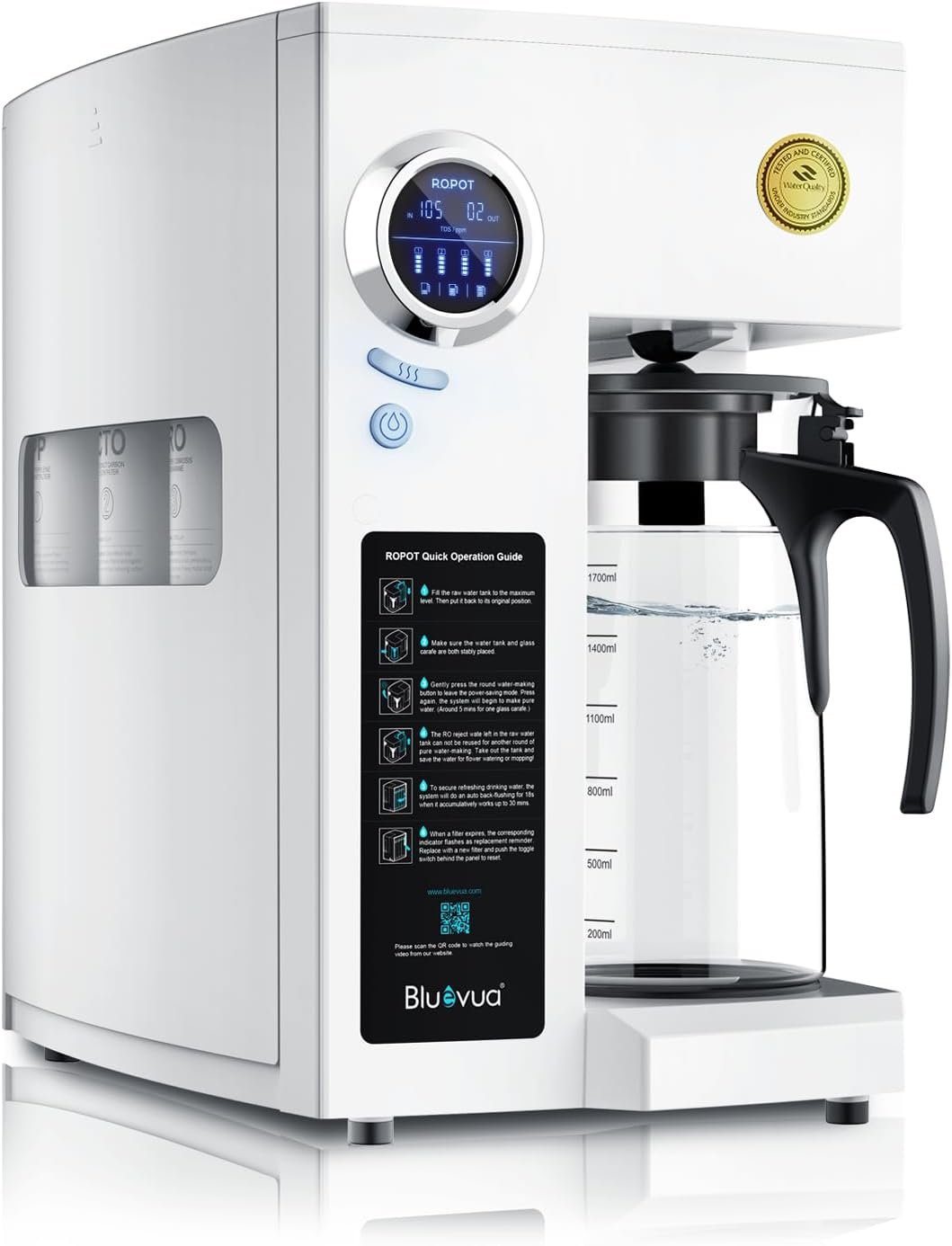
Bluevua RO100ROPOT Countertop Water Filter
As an Amazon Associate I earn from qualifying purchases.
The Bluevua RO100ROPOT Countertop Water Filter brings reverse osmosis technology into the kitchen without requiring permanent plumbing alterations or an under-sink installation.
Combining a multi-stage filtration system, digital water-quality monitoring and a removable glass carafe, it provides an alternative to conventional water-filter pitchers and permanently installed drinking water systems.
Its main attraction is the combination of sophisticated filtration and straightforward everyday operation.
Rather than connecting directly to the household water supply, the RO100ROPOT uses a manually filled reservoir. The system processes the water through its filters and collects the finished drinking water in a glass carafe.
The result is a self-contained appliance designed for people who want more control over their drinking water without undertaking kitchen modifications.
However, reverse osmosis also introduces considerations that ordinary water-filter jugs do not have, including wastewater, electrical operation and periodic filter replacement.
Understanding those differences is essential before deciding whether the Bluevua deserves a permanent place on the kitchen counter.
Why it works in a modern kitchen
The Bluevua RO100ROPOT is designed around convenience.
Traditional under-sink reverse osmosis systems typically require a connection to the cold-water supply, a separate drinking water tap and a route for wastewater.
That arrangement can work well in a permanently fitted kitchen, but it is not necessarily practical for everyone.
Tenants may be unable to modify existing plumbing, while homeowners may prefer to avoid additional pipework or alterations to their worktops.
The Bluevua takes a different approach.
The appliance sits on the counter, requiring a suitable electrical outlet and access to tap water for filling the reservoir.
There is no need to drill through a worktop or install a separate drinking water tap.
This makes it particularly interesting for apartments, rented homes and kitchens where a conventional reverse osmosis installation would be inconvenient.
Its white housing and simple design also help it blend into a modern kitchen without looking excessively industrial.
The glass carafe is a welcome detail.
Instead of dispensing into a permanently fitted plastic collection vessel, the system produces filtered water in a removable container that can be carried to the dining table or placed in the refrigerator.
That gives the appliance a practical advantage over systems that require drinking water to be collected one glass at a time.
It is not a tiny countertop device, however, and sufficient space must be allowed for both the main unit and routine reservoir handling.
How the five-stage filtration works
The principal technology behind the RO100ROPOT is reverse osmosis.
Unlike a basic water-filter pitcher, which commonly relies on activated carbon and ion-exchange media, the Bluevua uses a reverse osmosis membrane as part of a more extensive treatment process.
Bluevua describes the system as using five filtration stages.
The first stage is a polypropylene sediment filter designed to capture larger particles such as sand, rust and suspended debris.
Removing these particles helps protect the components that follow.
The second stage uses a coconut-shell carbon block filter.
Activated carbon is commonly used in drinking water treatment to reduce chlorine-related tastes and odors, making it useful when tap water has an unpleasant smell or flavour.
The third stage is the reverse osmosis membrane.
This is the heart of the system.
Reverse osmosis uses pressure to move water through a semipermeable membrane while separating a substantial proportion of dissolved substances from the finished water.
The technology is capable of reducing many dissolved minerals and certain contaminants, although actual performance depends on the membrane, the water supply, operating conditions and the specific substances involved.
The fourth stage uses a post-carbon filter intended to improve the taste and smell of the processed water.
Finally, Bluevua describes a remineralisation stage that adds minerals such as calcium and magnesium back into the treated water.
The aim is to provide a more balanced drinking experience after the reverse osmosis process has removed much of the original dissolved mineral content.
Because Bluevua sells several related models and filter configurations, buyers should check which remineralisation components are included with the exact package being purchased.
The important distinction is that this is a genuinely multi-stage water-treatment appliance rather than a basic jug with an electronic display attached.
What the digital water-quality display tells you
One of the features that makes the Bluevua particularly suitable for GizRPT is its electronic monitoring system.
The digital display provides readings for the incoming and filtered water.
These readings are expressed as TDS, or total dissolved solids.
TDS is a measure of dissolved substances in water, including minerals and salts.
By comparing the incoming and outgoing readings, the owner can observe how much the overall dissolved-solids level changes during filtration.
For someone interested in how a water-filtration system operates, this is useful information.
Instead of relying entirely on the assumption that the filters are doing their job, there is a visible indication of the membrane’s general performance.
The display also provides information about filter life.
That is more convenient than attempting to remember when several different filter cartridges were installed.
However, the TDS display must be understood correctly.
A low TDS reading does not, by itself, establish that drinking water is safe.
TDS monitoring does not identify individual contaminants such as bacteria, pesticides or particular industrial chemicals.
Some harmful substances may be present at concentrations that are not meaningfully revealed by an ordinary TDS measurement.
Likewise, water containing naturally occurring calcium and magnesium may have a higher TDS reading without being unsafe.
The display is therefore best treated as a helpful operational indicator rather than a complete laboratory analysis of water quality.
This distinction matters, particularly for households with known contamination concerns.
What independent certification actually means
Water-filtration claims deserve closer examination than ordinary appliance marketing.
Bluevua publishes information about filtration performance and refers to independent testing and certification.
However, different testing standards assess different aspects of a drinking water system.
The RO100ROPOT appears in an official NSF listing for NSF/ANSI/CAN 372, which concerns lead-content requirements for materials and components.
This is a useful form of third-party verification, but it does not mean the appliance has been certified under that standard to remove lead from the water passing through it.
Those are two different questions.
Lead-content compliance concerns the materials used in the drinking water equipment.
Certified contaminant reduction concerns how effectively a treatment system removes particular substances from incoming water under specified test conditions.
Bluevua also has published laboratory testing relating to aspects of the RO100ROPOT’s treatment performance.
Nevertheless, individual test results should not be confused with certification covering every contaminant mentioned in promotional material.
A sensible buyer should look for documentation covering the exact model and the specific substance of concern.
This is especially important for anyone purchasing a filter because of a known local water-quality problem.
The RO100ROPOT is designed for treating suitable tap water. It should not automatically be regarded as a substitute for testing an unsafe private well, following a boil-water advisory or addressing a serious contamination incident.
Where water safety is uncertain, the appropriate starting point is reliable local water testing and official public-health guidance.
The Bluevua’s filtration technology is a meaningful feature, but its capabilities should be understood through evidence rather than broad promises.
What it feels like to use
The everyday process is relatively straightforward.
The user fills the raw-water reservoir with suitable tap water, places the glass carafe into position and operates the filtration controls.
The system then processes the water, with the finished supply collecting in the removable carafe.
Because it works in batches, the routine is different from opening a dedicated drinking water tap.
Water must be prepared before it is needed.
For one or two people, this may be perfectly manageable.
A household that consumes large quantities of filtered water throughout the day may need to run the appliance more frequently.
Bluevua’s glass carafe has an approximate capacity of 1.7 litres.
That is useful for filling several drinking glasses, preparing cold drinks or keeping a supply in the refrigerator.
It is also small enough to be carried and poured without having to move the main appliance.
Another practical advantage is that the system does not have to remain connected to the household plumbing.
If the kitchen is rearranged or the appliance needs to be moved, there is no permanent water connection to disconnect.
The main requirement is a suitable, stable surface near an electrical outlet.
The controls and filter-life indicators should make the system approachable for people who do not want to manage complicated equipment.
Nevertheless, the convenience is conditional on accepting a regular routine of filling, filtering, emptying and cleaning.
For someone accustomed to obtaining drinking water immediately from a tap, that extra involvement may take some adjustment.
The glass carafe makes a practical difference
The removable glass carafe is one of the most attractive elements of the RO100ROPOT.
Many countertop filtration appliances use plastic containers for collecting and storing drinking water.
Bluevua uses a borosilicate glass carafe, giving the finished-water container a more substantial and traditional appearance.
Glass is also useful because it does not retain odors in the same way that some poorly maintained plastic containers can.
The carafe can be brought to the table, used for serving water or placed in the refrigerator.
This makes the appliance feel more like part of the kitchen rather than a piece of specialist treatment equipment.
The ability to separate the drinking water from the machine is also convenient when preparing meals or entertaining guests.
Instead of repeatedly returning to the filtration unit, the carafe can be placed wherever the water is needed.
There are practical limitations.
Glass remains breakable, and the container requires suitable handling and cleaning.
The carafe also needs to be correctly positioned for the machine to operate as intended.
Anyone with young children or a particularly busy kitchen should consider whether a removable glass vessel is the most convenient arrangement.
Even so, it is an appealing feature for households that prefer glass containers for drinking water.
Filter life and routine maintenance
A reverse osmosis system is not a fit-and-forget appliance.
The Bluevua uses several replaceable filters, and their condition affects how efficiently the machine can operate.
According to the manufacturer’s operating guidance, the sediment, carbon-block and post-carbon filters have recommended replacement intervals of approximately 12 months.
The reverse osmosis membrane has a longer suggested interval of approximately 12 to 24 months.
Actual replacement requirements depend on water quality, the amount of water processed and the condition of the system.
Any remineralisation filter has its own replacement requirements.
The display helps by providing filter-life information, but owners must still obtain the correct replacement cartridges and install them properly.
Regular cleaning is also necessary.
Mineral deposits can accumulate within water-treatment equipment, particularly in areas with hard water.
If scale builds up, filtration may become slower or less effective.
Bluevua provides maintenance guidance for cleaning, flushing and descaling the appliance.
It also uses automatic backflushing as part of the filtration operation.
These features are helpful, but they do not remove the need for periodic attention.
The raw-water reservoir and glass carafe should be kept clean, and the remaining concentrated water should be discarded in accordance with the manufacturer’s instructions.
Anyone considering this model should think about the ongoing maintenance routine, not simply the convenience of the initial installation.
The drawbacks
The Bluevua RO100ROPOT has several practical advantages, but it is important to understand where the design makes compromises.
The first drawback is that it occupies valuable countertop space.
Although the appliance avoids under-sink installation, the filtration equipment still needs to be accommodated somewhere.
The machine is considerably larger than a conventional water-filter pitcher.
It must be positioned near an electrical outlet, with enough surrounding space to handle the raw-water reservoir and glass carafe.
In a large kitchen this may not be particularly troublesome.
In a compact apartment, however, worktop space is often reserved for appliances that are used throughout the day.
A coffee machine, toaster, kettle and food-preparation area may already occupy much of the available surface.
Adding a countertop reverse osmosis system requires a deliberate decision about which appliances deserve permanent space.
It is worth checking the available dimensions and the clearance required for everyday access before purchasing.
The second drawback is the need to refill the reservoir manually.
An under-sink filtration system connected directly to the water supply can provide filtered water without requiring the user to carry water to the appliance.
The Bluevua works differently.
Its reservoir must be filled with tap water, and the finished water is produced in batches.
That is part of what makes installation straightforward, but it also creates repetitive work.
Someone drinking several glasses of water each day may find the process simple enough.
A larger household preparing drinking water, hot drinks and cooking water may need to repeat the process frequently.
This is especially relevant when guests are visiting or several people need water at the same time.
There is no permanent connection supplying unlimited filtered water on demand.
For some households, avoiding plumbing changes is worth the inconvenience.
For others, an installed filtration system may be more suitable.
Reverse osmosis also creates reject water.
This is one of the most important differences between an RO system and a conventional filtered-water jug.
During reverse osmosis, some of the incoming water becomes finished drinking water, while another portion carries away concentrated dissolved substances.
The Bluevua retains this reject water in the raw-water reservoir arrangement.
The manufacturer’s instructions advise discarding the remaining reject water rather than repeatedly processing the same concentrated water.
That means not every litre placed into the machine becomes drinking water.
The exact balance between finished water and wastewater can vary with water quality and operating conditions.
This may be a concern for households trying to minimise water consumption.
It also adds another step to the routine, because leftover water must be emptied before the next appropriate filling cycle.
Anyone seeking a system that produces virtually no wastewater should consider this limitation carefully.
The appliance requires electricity.
A basic water-filter pitcher works without a power supply.
The Bluevua uses electrically powered components to drive the reverse osmosis process and operate the digital controls.
That means it must be positioned close to an appropriate socket.
It also cannot provide its normal filtration function during a power outage.
For most households, this may be a minor consideration.
However, people who value entirely passive water-filtration equipment may prefer a simpler alternative.
Electrical operation also introduces another component that could require attention over the appliance’s lifespan.
The convenience of automatic filtration and monitoring comes with the additional complexity of a powered machine.
Filtration takes time rather than being instantaneous.
The RO100ROPOT does not provide the same immediate experience as turning on a normal tap.
Water passes through several treatment stages before entering the carafe.
That process takes time, and flow rate may vary depending on incoming water quality, temperature and filter condition.
When a full carafe is already prepared, the system is convenient.
When the container is empty and drinking water is needed immediately, the wait becomes more noticeable.
This may be frustrating in a busy kitchen, particularly when water is being used for several purposes.
The most practical approach is to prepare filtered water in advance.
People who prefer unlimited drinking water available immediately may find a permanently installed system more convenient.
Replacement filters are an ongoing commitment.
The RO100ROPOT has several filtration components, each with a service life.
Some cartridges require more frequent replacement than the membrane, and maintenance intervals depend partly on the water being treated.
The user must also source compatible Bluevua replacement filters.
These are not generic cartridges that can automatically be replaced with any similarly shaped filter.
Availability of genuine replacement parts should therefore be considered before choosing the appliance.
The expense of replacing multiple filters over several years is another relevant factor, even though the precise amount will depend on usage and the components required.
Ignoring replacement schedules may reduce filtration performance and undermine the reason for purchasing a reverse osmosis system in the first place.
The digital display has limitations.
The TDS monitoring system is useful for observing changes in dissolved solids, but the readings can be misunderstood.
A low reading is not a comprehensive guarantee of water safety.
The display cannot identify every individual substance that might be present.
It does not replace professional testing where there is a specific concern about lead, microorganisms, agricultural chemicals or other contaminants.
A user who interprets the TDS number as a complete safety assessment could develop misplaced confidence in the appliance.
The best approach is to understand the display as an indication of general filtration behaviour.
It is a useful electronic feature, not a laboratory.
Contaminant-removal certification must be checked carefully.
Bluevua’s published information includes claims about reducing a wide range of substances.
Reverse osmosis technology is capable of reducing many dissolved contaminants, but a broad technology claim is not the same as independently certified performance for every substance.
The RO100ROPOT’s NSF/ANSI/CAN 372 listing concerns lead content in the system’s components.
It should not be mistaken for certification demonstrating that the appliance removes lead from incoming water to a specified level.
This distinction is particularly important for people who are concerned about a known contaminant in their local water supply.
A buyer should seek evidence for the exact model and exact contaminant rather than relying on general claims about reverse osmosis.
Where the safety of the incoming water is uncertain, proper testing and appropriate treatment advice remain essential.
The system should not be treated as an automatic solution for every water source.
The manufacturer specifies tap water as the intended supply.
Someone relying on a private well, untreated surface water or another uncertain source should not assume that the appliance alone makes that water safe.
Water can contain microbiological or chemical hazards that require specialist treatment and monitoring.
This standard RO100ROPOT should also not be confused with Bluevua’s separate UV-equipped version.
The presence of advanced filtration does not mean every model includes an ultraviolet treatment stage.
Understanding the precise model is particularly important when comparing closely related water purifiers.
The glass carafe needs careful handling.
Although glass is attractive and convenient for serving water, it is more vulnerable to impact damage than a sturdy plastic container.
Dropping it onto a tiled kitchen floor could result in breakage.
The carafe also needs regular cleaning and careful positioning on the appliance.
For households where drinking water is frequently handled by young children, a different container design might be more practical.
Bluevua offers replacement accessories, but breakage still creates inconvenience.
The choice of glass is a genuine design advantage for some households and a practical disadvantage for others.
The appliance requires cleaning and occasional descaling.
The automatic backflushing function helps maintain the filtration process, but it does not make the machine self-maintaining.
Hard-water deposits can accumulate over time.
The reservoir, carafe and water-contact surfaces must also be kept clean.
Cleaning becomes particularly important if the appliance is used infrequently or left standing for extended periods.
Users need to follow the manufacturer’s instructions concerning storage, flushing and maintenance after periods of inactivity.
Anyone hoping to purchase a water-filtration appliance that can be left unattended for months may find this requirement inconvenient.
Reverse osmosis changes the mineral composition of drinking water.
An RO membrane removes a substantial proportion of dissolved minerals along with other dissolved substances.
That can change the taste of the finished water.
Some people enjoy the lighter taste of reverse osmosis water, while others prefer the flavour associated with naturally occurring minerals.
Bluevua’s remineralisation stage is intended to address this by adding certain minerals back into the treated water.
However, the taste of drinking water is personal, and remineralisation should not be mistaken for a comprehensive nutritional benefit.
The amount and composition of added minerals depend on the filtration arrangement.
Buyers should choose this appliance primarily for its water-treatment capabilities and convenience rather than expecting significant health improvements from the addition of minerals.
Finally, it may be more complicated than some households need.
Not everyone requires reverse osmosis filtration.
Where drinking water is already safe, tastes acceptable and meets household needs, a simpler filter may be entirely sufficient.
A conventional pitcher does not require electricity, several filter cartridges or wastewater management.
The Bluevua offers more sophisticated technology, but that technology brings additional responsibilities.
The deciding question is whether the extra filtration capability and monitoring features address a genuine requirement.
For the right household, the trade-off may be worthwhile.
For someone who simply wants chilled drinking water with a slightly improved taste, a less complicated option may be more appropriate.
Who it suits best
The Bluevua RO100ROPOT is particularly well suited to households that want a countertop reverse osmosis system without permanent plumbing modifications.
It makes sense for apartment residents, renters and homeowners who prefer not to install a separate filtered-water tap.
It should also appeal to people who enjoy useful kitchen technology and appreciate being able to monitor the filtration process.
The digital display, replaceable filtration components and automatic operating functions provide more information and control than a conventional water-filter pitcher.
The glass carafe makes the finished water convenient to store and serve, particularly for smaller households.
It is also a reasonable option for someone who wants reverse osmosis treatment but does not have space beneath the sink for an installed system.
However, families requiring large volumes of filtered water throughout the day may prefer the convenience of a permanently connected system.
Anyone relying on an uncertain or potentially contaminated water source should first establish the appropriate treatment requirements through reliable testing and guidance.
Is it worth the kitchen counter space?
The Bluevua RO100ROPOT Countertop Water Filter brings together useful filtration technology and a practical, self-contained design.
Its five-stage treatment arrangement, reverse osmosis membrane and digital monitoring distinguish it from conventional water-filter pitchers.
The removable glass carafe is a particularly attractive feature, allowing filtered water to be taken to the table or stored in the refrigerator.
The lack of permanent plumbing requirements also makes the appliance more accessible to households that cannot easily install an under-sink system.
There are meaningful drawbacks.
The reservoir requires manual refilling, the filtration process produces reject water, and replacement cartridges create an ongoing maintenance commitment.
The appliance also occupies counter space and requires electricity.
Most importantly, the digital TDS readings and general filtration claims should not be confused with proof that every possible contaminant has been removed.
Its appeal lies in providing a practical countertop reverse osmosis arrangement with useful electronic monitoring, not in promising perfect water under every circumstance.
For a household that specifically wants reverse osmosis filtration without altering existing plumbing, the RO100ROPOT is a worthwhile option to consider.
For someone who values straightforward kitchen technology and is comfortable with routine maintenance, it offers an interesting balance of filtration capability, convenience and design.
For more innovative kitchen appliances, smart coffee equipment and useful home technology, explore our Kitchen & Coffee guides.
As an Amazon Associate I earn from qualifying purchases.