
Airthings View Plus Smart Air Quality Monitor
As an Amazon Associate I earn from qualifying purchases.
The Airthings View Plus Smart Air Quality Monitor offers a detailed picture of the air inside your home, bringing seven environmental measurements together in one compact, connected device.
It monitors radon, carbon dioxide, fine airborne particles, volatile organic compounds, humidity, temperature and air pressure. Instead of relying on guesswork, homeowners can see how indoor conditions change throughout the day and identify patterns that might otherwise go unnoticed.
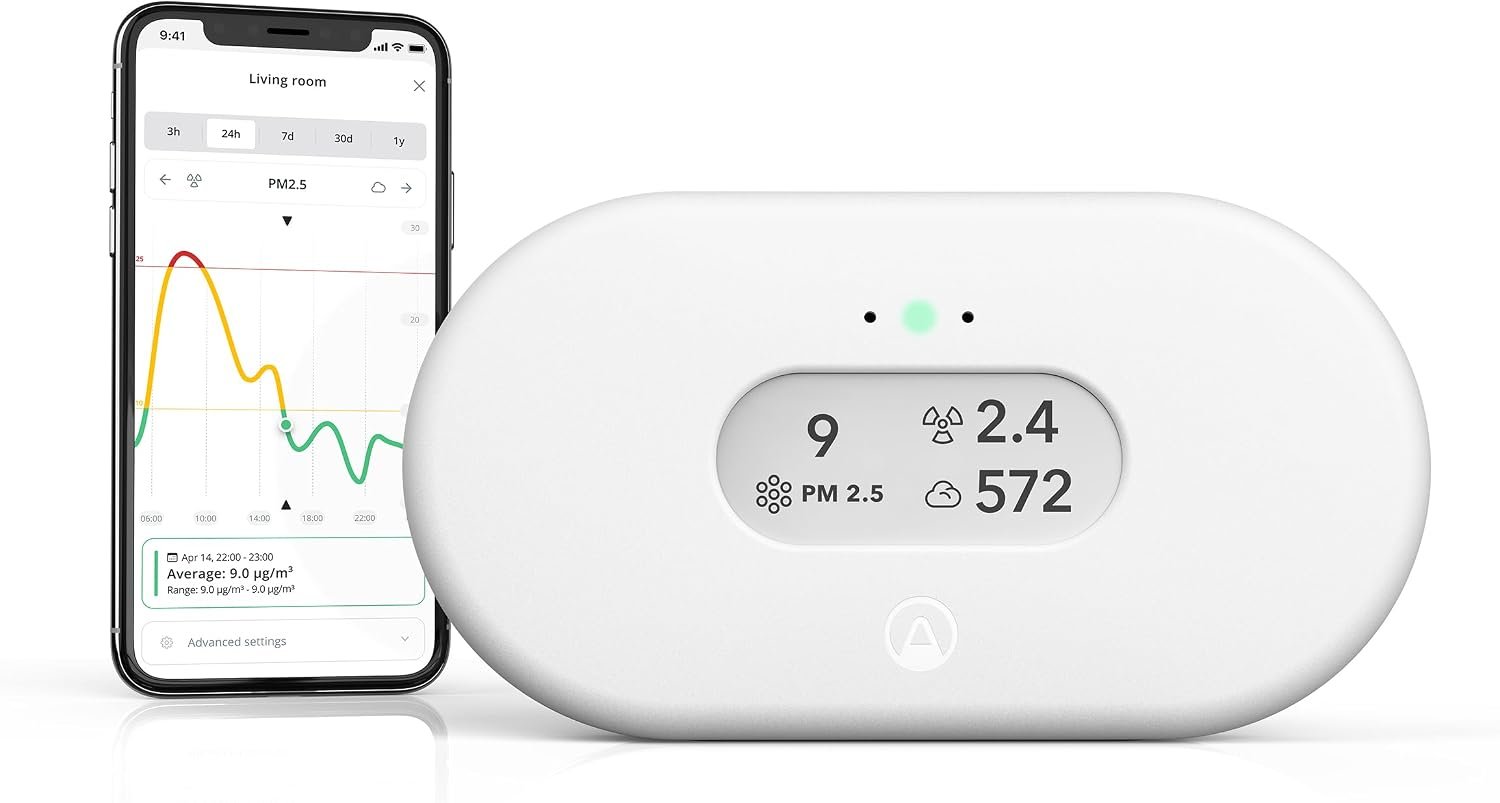
With Wi-Fi connectivity, a low-energy E Ink display and the Airthings smartphone app, the View Plus makes environmental monitoring surprisingly accessible.
Its greatest strength is not simply collecting measurements. It is helping people understand what happens to indoor air when windows remain closed, rooms become occupied, cooking produces airborne particles or ventilation is insufficient.
For anyone interested in practical smart-home technology, the Airthings View Plus provides information that can lead to more informed everyday decisions.
Why It Works in a Smart Home
Smart-home technology is most useful when it solves a genuine problem or provides information that helps improve daily living.
The Airthings View Plus takes an area of home management that is normally invisible and makes it measurable.
Unlike a conventional thermometer or humidity gauge, it monitors several different environmental conditions simultaneously.
This makes it particularly useful in bedrooms, living rooms, home offices and other regularly occupied spaces.
For example, carbon dioxide levels can rise when several people spend time in a closed room. The View Plus provides information that can help identify when additional ventilation may be beneficial.
Its particulate matter sensor can also highlight changes associated with cooking, smoke or airborne dust.
These measurements become more useful when viewed over time rather than treated as isolated numbers.
The Airthings app allows homeowners to explore historical readings and see whether certain activities or conditions repeatedly affect their indoor environment.
Rather than controlling the home directly, the View Plus provides the information needed to make better decisions about ventilation, filtration and general indoor comfort.
Seven Sensors With Practical Benefits
The View Plus combines seven measurements, each providing a different piece of information about indoor conditions.
Radon Monitoring
Radon is a naturally occurring radioactive gas that can enter buildings through the ground.
It has no smell or colour, making dedicated testing necessary to determine whether it is present at elevated concentrations.
The View Plus continuously monitors radon and builds a picture of exposure over time.
This is particularly valuable because radon levels can change with weather, ventilation and building conditions.
Long-term averages are much more meaningful than individual readings.
For homeowners in areas where radon is a concern, continuous monitoring provides information that occasional spot checks may miss.
Carbon Dioxide Monitoring
Carbon dioxide levels can provide a useful indication of ventilation in occupied rooms.
When people spend extended periods indoors with windows closed, CO₂ concentrations may gradually rise.
The View Plus uses a dedicated non-dispersive infrared sensor to measure CO₂.
This can help homeowners recognise when a room may benefit from fresh air, particularly in bedrooms, home offices and shared living spaces.
It is important to remember that carbon dioxide monitoring is not the same as carbon monoxide detection.
The View Plus does not detect carbon monoxide and cannot replace a dedicated CO alarm.
Fine Particle Detection
The PM2.5 sensor measures concentrations of fine airborne particles.
These particles can originate from cooking, smoke, outdoor pollution and other everyday activities.
Monitoring PM2.5 can help identify changes that would otherwise be difficult to notice.
For example, readings may increase during certain cooking activities or when outdoor pollution enters through open windows.
The information can help homeowners assess whether ventilation or an appropriate air purifier is making a useful difference.
VOC, Humidity, Temperature and Pressure
The remaining sensors measure volatile organic compounds, humidity, temperature and atmospheric pressure.
VOC monitoring can help reveal changes associated with cleaning products, furnishings and other chemical sources, although it cannot identify individual substances.
Humidity monitoring is useful for understanding conditions associated with condensation and general indoor comfort.
Temperature measurements provide additional context, while air-pressure readings help complete the environmental picture.
Together, these measurements make the View Plus more informative than a simple room thermometer or humidity meter.
What It Feels Like to Use
The Airthings View Plus has a restrained, modern appearance that suits contemporary home interiors.
Its white housing measures approximately 6.7 inches wide, 3.5 inches high and 1.3 inches deep.
The smooth, understated design avoids the bright screens and unnecessary decorative details found on some connected devices.
At approximately 12.7 ounces with batteries installed, it feels more substantial than its compact dimensions might suggest, without being particularly heavy.
It can stand on a suitable shelf or table, or be mounted on a wall.
The front features a 2.9-inch E Ink display, similar in principle to the low-energy screens used in electronic reading devices.
Rather than continuously glowing like a smartphone, the display presents information clearly without adding another bright screen to the room.
Users can choose up to four values to display, keeping the most useful measurements visible.
A motion-activated coloured indicator provides a quicker overview of general air quality.
Green, yellow and red illumination allows someone passing the monitor to recognise its current status without studying individual measurements.
This combination of simple visual feedback and detailed app-based information gives the View Plus a pleasingly practical character.
Wi-Fi Connectivity and the Airthings App
The View Plus connects to a compatible 2.4GHz Wi-Fi network, allowing measurements to be accessed through the Airthings app.
Initial setup uses Bluetooth and a compatible smartphone.
Once connected, the app provides access to individual sensor readings, historical trends and notifications.
This is where the device becomes particularly interesting.
A single carbon dioxide reading tells you something about a room at that moment.
A graph showing how CO₂ levels change during an evening, overnight or throughout the working day can reveal much more about normal ventilation patterns.
Similarly, particulate readings can help identify whether particular activities consistently coincide with poorer air quality.
The web dashboard offers further opportunities to explore historical information.
For users with compatible Airthings Wave monitors, the View Plus can also function as a hub when connected to Wi-Fi and powered through USB-C.
Supported smart-home integrations include Amazon Alexa, Google Assistant and IFTTT.
These features make it possible to incorporate indoor air-quality information into a broader connected-home arrangement, although available functions depend on the integration.
Flexible Power and Sensible Placement
The View Plus can operate using six AA batteries or a USB-C power connection.
Airthings advertises battery life of up to two years, although actual performance depends on settings, sampling frequency and network conditions.
USB-C power is particularly useful for users who prefer frequent particulate measurements and continuous operation without relying primarily on batteries.
Placement matters as much as connectivity.
Airthings recommends positioning the monitor around normal breathing height in a dry indoor location, away from direct sunlight, windows and ventilation outlets.
Keeping it in one suitable location also makes long-term measurements more consistent.
For most homes, a frequently occupied room provides a sensible starting point.
The Drawbacks
Although the Airthings View Plus offers comprehensive monitoring, buyers should understand what its sensors can and cannot achieve.
Its value depends on interpreting the measurements correctly rather than expecting the device to solve air-quality problems automatically.
It Does Not Improve Air Quality Itself
The most important limitation is that the View Plus measures indoor conditions but does not change them.
It cannot remove fine particles, reduce radon concentrations or introduce fresh air.
If the readings reveal a problem, the homeowner must still identify and address the underlying cause.
That might involve improving ventilation, using suitable filtration equipment or seeking professional advice about radon.
The monitor provides information to support those decisions, but it is not a substitute for the necessary equipment or remedial work.
For anyone expecting a self-contained air-quality solution, this distinction is essential.
Radon Measurements Require Patience
Radon cannot be assessed accurately through a single instant measurement.
The View Plus collects information continuously and calculates rolling averages.
Airthings recommends monitoring for at least 30 days, preferably longer, before drawing conclusions about long-term radon exposure.
Measurements during the first few days may fluctuate considerably as the device establishes a meaningful history.
This means the View Plus is not a tool for obtaining an immediate, definitive assessment of a property’s radon conditions.
Homeowners should be prepared to leave it in a suitable position and allow the data to accumulate.
Where elevated readings persist, professional testing and advice may be appropriate.
Some Sensors Need Initial Calibration
The carbon dioxide and VOC sensors require approximately seven days of initial calibration.
During this period, their measurements should not be treated as fully established readings.
This can be frustrating for buyers expecting every measurement to be immediately reliable after switching on the device.
The sensors also benefit from periodic exposure to fresh air as part of their normal calibration behaviour.
Although particulate matter, temperature, humidity and pressure measurements do not require the same initial calibration period, the device is most useful when allowed to monitor stable conditions over time.
It Is Not a Smoke or Carbon Monoxide Alarm
Despite measuring several airborne pollutants, the View Plus does not detect carbon monoxide or function as a conventional smoke alarm.
It also lacks the audible emergency alarm required for those safety applications.
This is an important distinction because CO₂ and CO are entirely different gases.
Homeowners must continue using correctly installed smoke and carbon monoxide alarms in the appropriate locations.
The View Plus is designed for environmental monitoring, not immediate emergency detection.
Wi-Fi and App Dependence
The View Plus provides useful information directly on its display, but detailed historical analysis and remote monitoring depend on its connected features.
It supports 2.4GHz Wi-Fi rather than 5GHz-only networks.
This may require some attention during setup, particularly with routers that combine wireless bands or use more complicated network arrangements.
The smartphone app is also important for selecting display values and exploring measurement history.
Anyone who prefers completely standalone equipment without an app or online account may find this less appealing.
Battery Life Depends on Settings
The advertised battery life of up to two years is a maximum under suitable operating conditions.
More frequent particulate sampling and wireless communication can increase power consumption.
When operating on batteries, the particulate sensor normally samples less frequently than it does with USB-C power.
Users can also reduce its sampling frequency to conserve battery life.
This introduces a compromise between measurement frequency and convenience.
For those wanting more frequent PM2.5 readings, a permanent USB-C connection may be preferable.
One Monitor Cannot Represent Every Room
Air quality can vary considerably between different areas of the same property.
A monitor positioned in the living room cannot necessarily describe conditions in a basement bedroom, kitchen or upstairs office.
Temperature, ventilation, occupancy and pollution sources may differ throughout the building.
The View Plus is therefore best regarded as a detailed measurement point rather than a complete picture of every room.
Homeowners wanting broader coverage may need additional monitors, increasing the complexity and overall cost of the system.
VOC Measurements Have Limitations
The VOC sensor is useful for recognising changes in airborne chemical levels, but it does not identify individual chemicals or determine their precise health effects.
An increase in the reading may indicate that something has changed, but it does not automatically reveal which product or activity caused it.
Likewise, a reassuring VOC reading does not guarantee that every possible indoor pollutant is absent.
The measurements should be treated as useful environmental indicators rather than comprehensive chemical analysis.
The Display Is Intentionally Simple
The E Ink display is attractive and easy to live with, but it cannot show all seven measurements simultaneously.
Only selected values appear on the screen, meaning users need the app for a more complete picture.
E Ink also behaves differently from a conventional colour display, refreshing rather than continuously animating.
This restrained approach suits the product’s design, although anyone expecting a bright, highly interactive touchscreen may be disappointed.
Who It Suits Best
The Airthings View Plus is particularly suitable for homeowners who want a more complete understanding of their indoor environment.
It makes sense for people working from home, households interested in ventilation and air filtration, and anyone wanting to monitor radon over an extended period.
The compact design and E Ink display also suit living rooms, bedrooms and home offices where a permanently illuminated screen would be unwelcome.
People who enjoy examining data and using connected-home technology will appreciate the app’s historical measurements.
However, buyers seeking only temperature and humidity information may not need such an extensive device.
Similarly, anyone expecting automatic air purification or an immediate safety-warning system should consider equipment designed specifically for those purposes.
Is the Airthings View Plus Worth the Space?
The Airthings View Plus offers a thoughtful combination of environmental sensing, understated design and genuinely useful smart-home connectivity.
Its seven measurements provide a broader understanding of indoor conditions than conventional household monitors, while the E Ink display makes everyday information accessible without demanding constant attention.
Wi-Fi connectivity and historical graphs give the measurements additional value, helping homeowners recognise patterns rather than reacting to isolated readings.
The need for sensor calibration, long-term radon monitoring and occasional app interaction are real considerations.
Nevertheless, for someone interested in understanding the air inside their home and making better-informed decisions about ventilation and environmental comfort, the View Plus offers a capable and well-considered solution.
Explore more connected devices and practical household technology in our Smart Home & Security collection.
As an Amazon Associate I earn from qualifying purchases.