
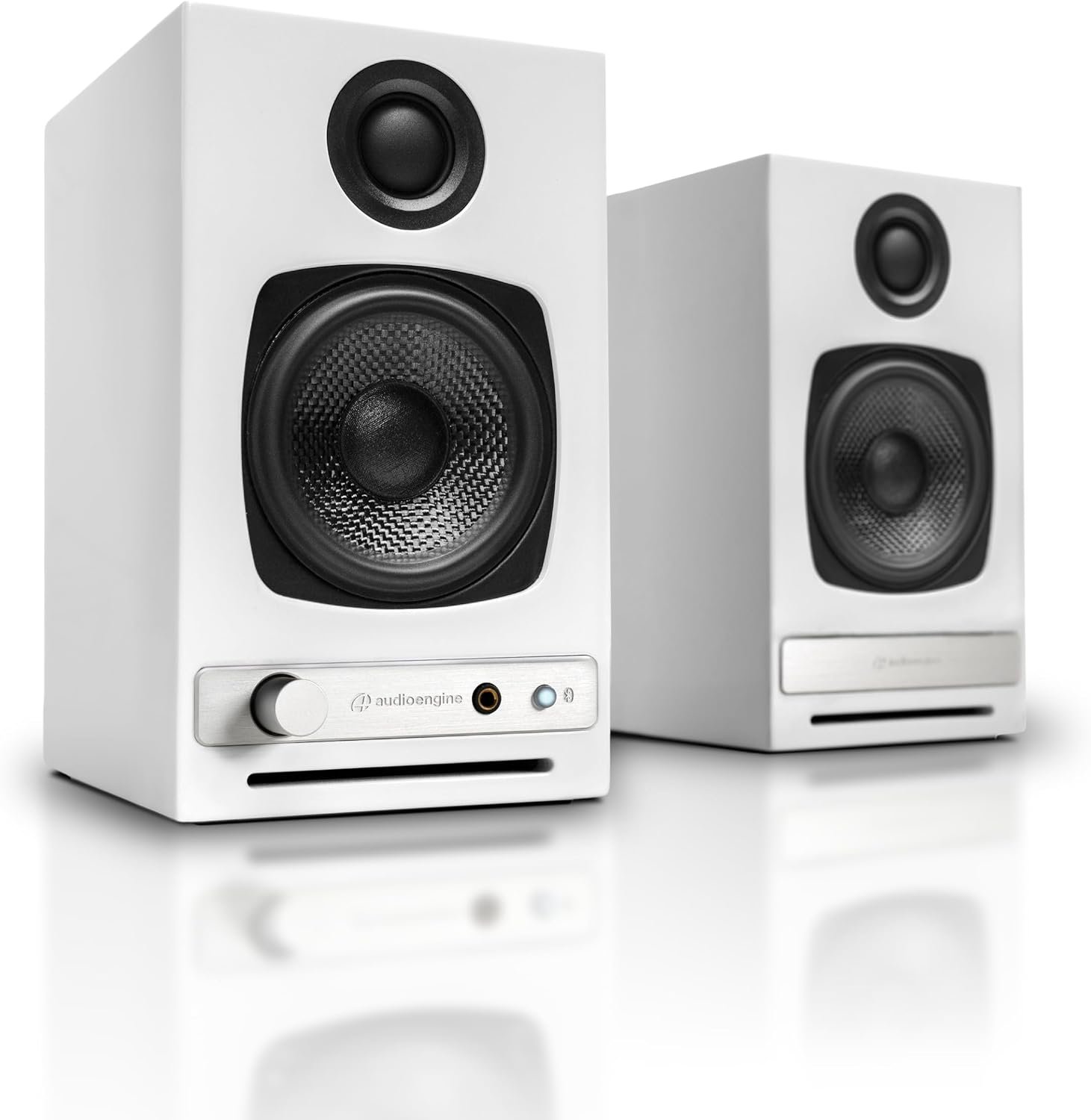
Audioengine A2 HD Wireless Speakers
As an Amazon Associate I earn from qualifying purchases.
The Audioengine A2 HD Wireless Speakers are designed for people who want proper stereo speakers on a desk without giving up most of the available workspace. They combine traditional powered-speaker construction with modern Bluetooth and USB-C connectivity, creating a compact system that can handle computers, phones, tablets and other audio sources without needing a separate amplifier.
Audioengine also refers to this model as the HD3 Next Gen, so the naming can look a little confusing at first. Underneath that, though, the idea is straightforward: two small powered speakers with the amplification, digital conversion and wireless connection already built in.
Each cabinet has a reassuringly solid feel rather than the hollow lightness of basic plastic computer speakers. The MDF construction, real-wood veneer on appropriate finishes and softly rounded edges give them more of a miniature bookshelf-speaker character.
Why they work on a desktop
Size is one of the strongest reasons to consider the A2 HD.
Each speaker measures roughly 7 inches high, 4.25 inches wide and 5.5 inches deep, so they can sit either side of a monitor without dominating a normal desk.
That compact footprint makes them particularly useful in a home office, bedroom workspace, gaming setup or smaller living area where full-size bookshelf speakers would feel excessive.
They are small, but they are not lightweight portable speakers.
The powered left speaker weighs around 3.8 lb, while the passive right speaker is about 3.4 lb. That weight, combined with the rigid cabinets, gives them a planted feel when placed on a desk.
The cabinets also use front-facing bass ports. That is useful in a desktop environment because speakers often end up relatively close to a wall, monitor or shelving.
What they feel like to use
The A2 HD keeps daily operation fairly simple.
The amplifier is built into the left speaker, while the right speaker connects to it using speaker cable. Once the system is positioned and powered, there is no separate amplifier taking up desk space.
The front-mounted volume control is easy to reach, which sounds like a small detail until you compare it with desktop speakers that hide basic controls around the back.
There is also a headphone output on the front.
Plugging headphones directly into the speaker means there is no need to reach behind a desktop computer or rely on a laptop’s headphone socket. Audioengine has built a dedicated headphone amplifier into the system, so this is more than simply an extension cable for the computer’s existing output.
Physically, the speakers have a fairly warm, furniture-like presence. They are compact enough to disappear visually beside a screen, but their wood-based cabinets and fabric-covered drivers make them feel more substantial than typical multimedia speakers.
Bluetooth without abandoning wired connections
Wireless audio is one of the main attractions.
The A2 HD uses Bluetooth 5.3 and supports aptX Adaptive, aptX HD, standard aptX, AAC and SBC.
That gives plenty of flexibility when streaming from a phone, tablet or computer.
The quoted wireless range is up to around 100 feet under suitable conditions, although walls, furniture and other wireless equipment can naturally affect that in a real home.
Bluetooth also makes the system useful beyond a dedicated computer setup. Someone working at a desk can switch from computer audio to music from a phone without physically reconnecting cables.
But these are not wireless-only speakers.
There are conventional analogue inputs alongside USB-C, so older equipment and wired sources are still welcome.
That balance is important because a pair of desktop speakers may remain in use for many years, while the devices connected to them change repeatedly.
USB-C and the built-in DAC
Connecting a computer through USB-C allows the speakers to use their own digital-to-analogue converter rather than relying entirely on the audio circuitry inside the computer.
The USB input supports digital audio at up to 24-bit depth, with 44.1 and 48 kHz sample rates.
For a compact desktop system, that keeps the arrangement pleasantly simple.
A laptop can connect directly to the speakers using one USB-C cable for audio, while the speakers handle the digital conversion themselves.
There is no need to add a separate desktop DAC simply to improve on a basic computer headphone output.
This is one of the features that gives the A2 HD a genuine technology angle rather than making them simply another pair of Bluetooth speakers.
Small drivers in proper cabinets
Each speaker uses a 2.75-inch aramid-fibre woofer paired with a 0.75-inch silk-dome tweeter.
The material choices are more in line with conventional hi-fi speakers than inexpensive desktop multimedia systems.
Aramid fibre gives the woofer cone useful stiffness without excessive weight, while the soft silk tweeter is designed for the higher frequencies.
The internal Class AB amplification delivers 15 watts RMS per channel, with 60 watts total peak output across the system.
Numbers alone never tell you how a speaker will sound, but they do help put the A2 HD into context.
These are compact near-desktop speakers intended for listening in a smaller space. They are not designed as giant party speakers or substitutes for large floorstanding loudspeakers.
Useful connections beyond the computer
The A2 HD has enough connection options to work with more than one device.
Alongside Bluetooth and USB-C, there are 3.5 mm and RCA analogue inputs.
There is also a variable RCA output.
That becomes particularly useful if you later decide that the compact speakers need more help at the bottom end, because an external powered subwoofer can be added without replacing the whole system.
A bass-reduction switch is provided for that sort of arrangement, allowing some low-frequency work to be handed over to a subwoofer.
That makes the A2 HD more expandable than their size initially suggests.
The drawbacks
The most obvious compromise is bass extension.
Small cabinets and 2.75-inch woofers can only move so much air. Audioengine specifies a frequency response beginning at around 65 Hz, which is respectable for something this compact but does not reach into the genuinely deep bass territory that larger speakers or a dedicated subwoofer can produce.
For voices, acoustic music, general desktop listening, games and everyday music, that may be perfectly adequate.
But someone who expects the physical low-end weight of larger bookshelf speakers could find them restrained.
Electronic music, film soundtracks and bass-heavy recordings are the areas where the size of the cabinets is most likely to become apparent.
Fortunately, the subwoofer output provides a sensible upgrade route, but that means buying and finding space for another piece of equipment.
Their size also limits how convincingly they can fill a large room.
Audioengine positions these speakers for desktops and smaller spaces, and that is where they make the most sense. Putting them at one end of a large open-plan living room and expecting the scale of much larger hi-fi speakers would be asking them to do the wrong job.
Placement deserves some thought as well.
Although they are small enough to sit directly on a desk, placing any speaker flat on a hard surface can introduce unwanted reflections or vibration.
Users who want to get the best from them may eventually consider small isolation stands or angled desktop stands. That improves positioning, but it also adds cost and makes the supposedly tiny speaker setup occupy a little more vertical space.
The two-speaker arrangement still involves cables.
Bluetooth removes the cable between the source device and the speakers, but it does not make the whole system wireless. The powered left speaker needs mains power, and the right speaker must be connected to the left.
Anyone expecting the completely cable-free feel of battery-powered wireless speakers may therefore be disappointed.
They are also very much stationary speakers.
There is no internal battery. These are intended to live on a desk, shelf or piece of furniture rather than being carried into the garden or moved from room to room every afternoon.
The Bluetooth connection is convenient, but this should not be confused with a portable Bluetooth speaker.
Another limitation is the USB sample-rate ceiling.
The built-in digital system is entirely sensible for everyday music, gaming and desktop listening, but people who collect very high-resolution audio files and insist on playing them natively at much higher sampling rates may prefer a different DAC and speaker arrangement.
For most people this is unlikely to matter. For someone building a dedicated audiophile digital system, it could.
The speakers also sit in an awkward middle ground for certain buyers.
They are much more substantial than inexpensive computer speakers, yet they remain considerably smaller than traditional passive hi-fi speakers.
Someone who has plenty of room may decide that a larger pair of powered bookshelf speakers offers more scale and deeper bass.
Someone who only wants background audio may decide that a single inexpensive Bluetooth speaker is simpler.
The A2 HD makes the most sense when compact size and better-quality stereo reproduction are equally important.
There is also the matter of stereo placement.
A single Bluetooth speaker can simply be dropped onto a shelf. With the Audioengine pair, you need enough desk width to place one speaker on either side of the listening position.
That is precisely what creates a proper stereo image, but a very narrow or cluttered desk could make positioning awkward.
The gloss finishes may require a little extra care too. Smooth painted surfaces can show fingerprints and dust more readily than textured plastic, particularly in a workspace where hands are constantly moving equipment around.
Finally, their understated design will not suit everyone.
There are no dramatic RGB lights, oversized control panels or conspicuous gaming details. These speakers look more like miniature traditional hi-fi equipment.
For GizRPT that restraint is actually appealing, but somebody wanting a highly visual gaming aesthetic may find them almost too quiet in appearance.
Who they suit best
The Audioengine A2 HD speakers make the most sense for someone who spends a lot of time at a computer and wants an upgrade from laptop speakers, monitor speakers or a basic plastic desktop set.
They are particularly well suited to home offices, compact workspaces, bedrooms and gaming desks where there is enough room for proper left-and-right speakers but not enough for a large hi-fi system.
The combination of Bluetooth and USB-C also suits people who regularly switch between a computer and mobile devices.
They should appeal to someone who values clean design and wants technology to sit comfortably in the room rather than dominate it visually.
Anyone who prioritises very deep bass, extremely high volume or large-room listening should probably consider larger speakers instead.
Is it worth the desktop space?
For a compact computer-audio setup, the Audioengine A2 HD Wireless Speakers manage to pack quite a lot into two small cabinets.
Bluetooth 5.3 provides easy wireless listening, while USB-C and the built-in DAC give a computer a more direct digital connection. The dedicated headphone amplifier, analogue inputs and variable output add flexibility that is easy to overlook when first looking at their modest size.
They also feel like small pieces of audio equipment rather than disposable computer accessories. The MDF cabinets, silk-dome tweeters and aramid-fibre woofers give them a more traditional loudspeaker character, both visually and physically.
Their limitations largely follow from their dimensions.
They cannot provide the deep bass or effortless scale of much larger speakers, and they still need mains power and a cable between the two cabinets.
But that is the trade-off.
For someone wanting proper stereo sound, modern connectivity and a relatively small footprint, the A2 HD occupies an appealing middle ground between basic computer speakers and a full-size hi-fi system.
or more connected audio and home-entertainment technology, explore our Audio, Computing & Entertainment guides.
As an Amazon Associate I earn from qualifying purchases.