
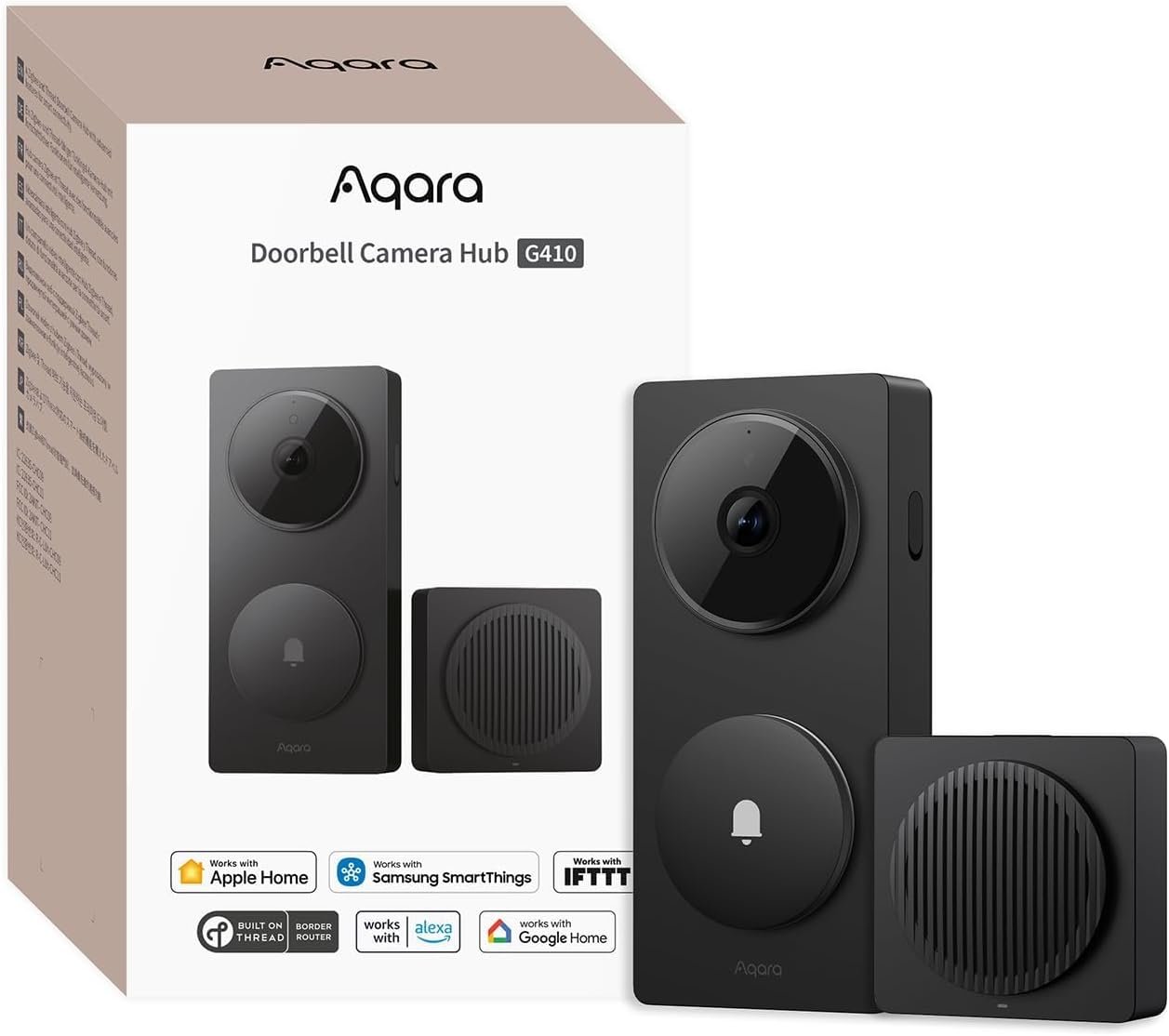
Aqara Doorbell Camera Hub G410
As an Amazon Associate I earn from qualifying purchases.
The Aqara Doorbell Camera Hub G410 does considerably more than tell you when someone has pressed the doorbell.
It combines a 2K video doorbell with an indoor chime and a surprisingly capable smart-home hub. Alongside live video and two-way conversation, the G410 can recognise familiar faces locally, detect someone lingering near the door using mmWave radar, record footage locally, and connect other Aqara and Matter-compatible devices around the home.
For somebody already building a connected home, that makes it far more interesting than a camera that performs only one job.
Why it works at the front door
The camera records at up to 2K resolution with a wide 175-degree field of view and a 4:3 image shape.
That wider, taller view is useful at a doorway because you are interested in more than just a visitor’s face. You may also want to see packages placed closer to the ground or somebody standing slightly to one side of the door.
Infrared night vision provides visibility when the entrance is dark.
The G410 also supports two-way audio, so somebody at the door can be seen and spoken to through the Aqara system without opening it.
None of those features is unusual on its own.
What separates the G410 is the amount of additional smart-home equipment Aqara has managed to build around the doorbell.
mmWave detection instead of relying only on motion
One of the more interesting features is the mmWave radar sensor.
Conventional motion detection can sometimes be triggered by things that are not particularly important — changes in light, movement outside the intended area, or objects moving near the entrance.
Aqara uses mmWave technology to help detect actual human presence and recognise when somebody remains near the door rather than simply passing briefly through the camera image.
That can make notifications more meaningful.
A person walking directly up to the door is very different from a tree moving in the background or a passing shadow.
The system can also use lingering presence as part of Aqara automations and alerts, giving the doorbell a role beyond waiting for somebody to press the button.
Local face recognition
The G410 also performs face recognition locally on the device.
Familiar faces can be labelled in the Aqara system and then used to trigger different notifications or smart-home routines.
For example, recognising a household member could trigger a different automation from detecting an unknown person.
The important part is that Aqara describes this recognition as taking place locally rather than requiring facial data to be sent away for cloud processing.
That does not remove every privacy consideration surrounding a connected camera, but local processing is a meaningful feature for people who prefer more of their home automation to remain inside the home.
The indoor chime is also a smart-home hub
The indoor unit is not simply a speaker that rings when somebody presses the doorbell.
The G410 acts as a Zigbee hub for Aqara devices, a Matter controller and a Thread Border Router.
That means the doorbell can become part of a much wider smart-home system.
Aqara Zigbee sensors, switches and other compatible devices can connect through the hub functionality.
Thread-based Matter devices can use the Thread Border Router.
The Matter controller allows compatible third-party Matter devices to be brought into Aqara Home.
For somebody starting a smart home, this could reduce the need to buy a completely separate hub immediately.
For an existing Aqara household, it gives the front-door camera another useful role rather than occupying space purely as a security accessory.
Works with the major smart-home platforms
Aqara lists compatibility with Apple Home, Google Home, Amazon Alexa and SmartThings, alongside its own Aqara platform.
Apple users also get support for HomeKit Secure Video.
There is an important specification to understand here: although the Aqara camera itself supports 2K resolution, Aqara states that video used through HomeKit Secure Video is limited to a maximum of 1200p.
That does not make HomeKit integration unimportant, but it does mean the full native 2K specification and the HomeKit Secure Video resolution are not identical.
Google Home, Alexa and SmartThings-compatible displays can also be used to view the live camera stream.
Wired or battery-powered installation
The G410 gives you two very different installation choices.
For the simplest installation, it can run from the six replaceable AA alkaline batteries supplied in the package.
Aqara quotes battery life of up to five months, while making clear that actual battery life depends on usage and environmental conditions.
That is useful if the property does not already have suitable doorbell wiring.
There is no need to run a new cable purely to get the basic system working.
Alternatively, the doorbell can be hardwired using 12–24V AC or DC power within Aqara’s specified limits.
Hardwiring removes battery replacement from normal use and also unlocks some of the G410’s more demanding recording features.
For a permanent home installation, that can make the wired option particularly attractive.
Local storage up to 512 GB
The G410 supports a Class 10 microSD card up to 512 GB, although the memory card itself is not included.
One appealing part of Aqara’s design is that the indoor chime/hub is part of the recording system.
Keeping storage equipment indoors means someone interfering with the outdoor doorbell cannot simply walk away with the entire recording device.
When the G410 is hardwired, Aqara supports 24/7 continuous local recording to the microSD card.
That last point is important.
Continuous recording is not simply a battery-powered feature you can enable without consequences. Aqara specifies continuous recording for the wired configuration.
There are also cloud-storage options through Aqara’s HomeGuardian service, but local recording gives users an alternative to relying entirely on remote subscription storage.
Dual-band Wi-Fi
The G410 supports both 2.4 GHz and 5 GHz Wi-Fi.
That provides more flexibility than doorbells restricted to 2.4 GHz alone.
2.4 GHz often travels farther and through walls more effectively, while 5 GHz can provide higher wireless performance when the router or access point is relatively close.
The best choice will depend on the layout of the house and the quality of the Wi-Fi signal at the front door.
A smart doorbell is only as useful as its connection.
If the entrance is at the far end of the property from the router, checking wireless coverage before mounting the device permanently is sensible.
What it feels like to use
The outdoor doorbell measures approximately 141.5 x 65 x 30.4 mm, while the indoor chime/hub is considerably smaller at roughly 65.2 x 65 x 28.4 mm.
The front unit is therefore visibly larger than a traditional push-button doorbell, which is hardly surprising considering it contains the camera, radar sensing, wireless hardware and batteries.
Aqara includes a 20-degree wedge bracket, which is useful where the camera needs to be angled towards the approach rather than pointing directly away from the wall.
The chime stays indoors and is powered by USB-C.
Aqara rates its speaker at up to 95 dB, and custom audio files can be used alongside the standard chime sounds.
Once configured, normal interaction is straightforward: receive an alert, look at the live image and speak to the visitor if necessary.
The deeper hub and automation features are there for people who want them without preventing the G410 from operating primarily as a doorbell.
Useful automation beyond security
This is where the G410 begins to feel more like a genuine smart-home product.
A recognised person arriving home could become an automation trigger.
Presence at the door could trigger indoor lighting.
An Aqara smart lock and the doorbell could form part of the same arrival routine.
Other Matter or Aqara devices can also take part because the G410 itself is providing hub functionality.
That is a much more useful approach than treating every smart device as its own isolated app.
A connected home becomes genuinely helpful when devices respond to one another rather than simply being controllable from the same phone.
The drawbacks
The G410 has a lot of technology inside it, and that naturally creates more complexity than a basic video doorbell.
The first thing to consider is the difference between battery and wired operation.
Running from six AA batteries makes installation easier, but some of the most demanding features are better suited to — or require — wired power.
Aqara specifically states that 24/7 continuous local recording is available only in wired mode.
The same applies to RTSP integration, which Aqara specifies as wired-only.
So somebody buying the G410 because they specifically want continuous recording or an RTSP stream should plan on hardwiring it rather than assuming the six AA batteries provide every feature.
Battery life also needs realistic expectations.
Aqara quotes up to five months, not five months guaranteed.
Frequent activations, live viewing, colder weather, busy entrances and other usage patterns can affect how long a set of batteries lasts.
A doorway facing a quiet private garden will place very different demands on the device from one facing a busy path with people constantly approaching.
The fact that the batteries are standard replaceable AA cells is convenient, but changing six of them several times a year may still become tiresome for some households.
Hardwiring avoids that issue.
The camera resolution also deserves some clarification.
The G410 itself is a 2K camera, but HomeKit Secure Video operates at up to 1200p on this model.
Apple Home users should therefore not assume they will receive the full native 2K stream through every Apple feature simply because “2K” appears on the product box.
The microSD card is another extra item.
The G410 supports up to 512 GB of local storage, but no microSD card is supplied.
If local recording is one of the main reasons you are choosing the product, a suitable Class 10 card needs to be added separately.
There is also a difference between local storage and completely subscription-free use of every possible service.
Core local features can operate without paying for cloud storage, but Aqara also offers its HomeGuardian cloud servicefor users who want cloud-based recording and related features.
That means you should decide whether local recording provides everything you need before assuming you will never have any interest in the optional cloud service.
The smart-home hub functions are powerful, but they can also be unnecessary.
If your house already has a dedicated Aqara hub, separate Thread Border Routers and an established Matter setup, some of what makes the G410 special may simply duplicate equipment you already own.
That does not stop the doorbell from working well as a camera, but it reduces the value of its all-in-one design.
Conversely, somebody new to Matter, Thread, Zigbee and smart-home automation may find the terminology confusing at first.
The G410 supports several wireless standards because they serve different purposes.
That flexibility is useful once everything is configured, but it also means the product is more technically involved than a simple doorbell with an app.
Wi-Fi quality is another important consideration.
The doorbell supports both 2.4 and 5 GHz networks, but a supported Wi-Fi band does not guarantee a strong connection at the installation point.
Brick walls, metal doors, distance from the router and crowded wireless environments can all affect performance.
Before drilling holes, it is sensible to test the intended position with the door closed and make sure the network remains reliable.
Physical size may also matter.
At more than 141 mm tall and 65 mm wide, the outdoor unit is not particularly discreet.
On a wide modern door frame it may look perfectly natural.
On a narrow traditional frame or beside decorative trim, finding the right mounting position could require more thought.
Aqara supplies a 20-degree wedge bracket, but that does not solve every unusual doorway layout.
The mmWave sensor should help reduce false alerts, but no detection system should be treated as infallible.
Placement, sensitivity settings and the entrance environment still matter.
You may need some experimentation before notifications behave exactly the way you want.
Face recognition is similarly dependent on the camera having a useful view of the person.
Someone with their face obscured, turned away or poorly illuminated may not be recognised in the same way as a person standing clearly in front of the camera.
Privacy is another consideration that deserves more than a passing thought.
A doorbell camera does not only record people living in the house. Depending on its position, it may capture neighbours, pedestrians, shared corridors or public areas.
Aqara provides privacy masking, allowing selected areas of the image to be blocked from recording.
That is useful, but responsible placement and configuration still remain with the owner.
The outdoor operating range is broad — Aqara specifies approximately -18°C to 50°C — but the indoor chime/hub is designed for indoor temperatures rather than being another weatherproof outdoor component.
The two pieces therefore need suitable locations.
Finally, the amount of functionality may simply be excessive for somebody who wants only to know when the delivery driver is at the door.
If you have no interest in Matter, Thread, Zigbee devices, local automations or face recognition, a simpler video doorbell may be easier to own.
The G410 earns its place when those extra capabilities are genuinely useful.
Who it suits best
The Aqara Doorbell Camera Hub G410 makes particular sense for somebody building a broader smart home rather than buying an isolated doorbell camera.
Existing Aqara users can use it as a hub for Zigbee devices.
Matter users gain a controller and Thread Border Router.
Apple Home households get HomeKit Secure Video support, while Alexa, Google Home and SmartThings users can bring the live view into compatible displays.
It also suits people who prefer the option of local storage instead of relying entirely on cloud recording.
And because battery or hardwired installation is available, the G410 can work both where existing wiring is present and where running new cable would be inconvenient.
Is it worth the smart-home space?
The Aqara G410 stands out because it combines several devices that would otherwise be separate.
It is a 2K video doorbell, an indoor chime, an Aqara Zigbee hub, a Matter controller and a Thread Border Router.
It adds mmWave presence detection, local facial recognition, local storage and support for the major smart-home platforms on top.
That breadth also creates the main compromises.
Some features require wired power, HomeKit does not use the full native 2K resolution, local storage requires a separate microSD card, and the large number of smart-home options means initial setup can be more involved than with a basic camera doorbell.
But for a household that genuinely wants the front door to become part of a wider connected-home system, the G410 does much more than simply show who pressed the bell.
It turns the entrance into another smart-home sensor and automation point while potentially replacing a separate hub at the same time.
Explore more connected devices in our Smart Home & Security section.
As an Amazon Associate I earn from qualifying purchases.